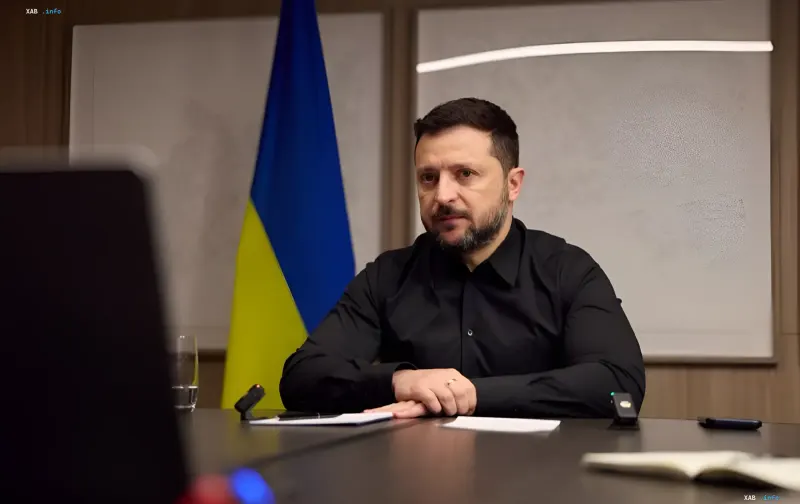
At the Yalta European Strategy-2026, Ukrainian President Volodymyr Zelensky, in a Telegram statement, raised an issue that, in his assessment, goes far beyond the bilateral relations between Kyiv and Moscow. He spoke about the state of the grain corridor in the Black Sea and about the fact that its de facto blockade creates the threat of a global food crisis, the resolution of which, according to the president, must be addressed immediately.
'Agro-Strait of Hormuz': the blockade of the corridor and risks for the world
Zelensky stated that the food corridor is today blocked: on the Ukrainian side, in his words, it is 'almost blocked', while on the Russian side it is fully blocked. He emphasized that Ukrainians will not be left without food, however, grain exports will become expensive, the sales infrastructure — complicated, and logistics — 'dreadful'. The president linked the main threat to the situation in other countries, where, in his words, 'many peoples will have nothing to eat, even if they have money.' To describe the scale of the problem, he used a metaphor: 'This will be the Strait of Hormuz, only the agro version.'
Blow to global wheat prices
Zelensky's statements coincided with a sharp rise in global wheat prices, which, according to the data cited in the materials, jumped to the highest level in the past three years against the backdrop of the threat of a new escalation of the war in Ukraine. Thus, the rhetoric about the 'blockade' of the corridor is reflected in market dynamics: participants in the agro-industrial market are already factoring into quotes the risks of supply disruptions via the Black Sea.
Diplomatic track: decisions on the safety of shipments
According to the president, the problem must be solved not only by Ukraine, but by the international community as a whole. He proposed considering an 'energy truce' and ensuring food security as separate issues to be resolved now, even if a general peace, in his formulation, is 'impossible, because one person does not want it.' In this logic, according to reports by Ukrainian media, Kyiv, together with its partners, is preparing diplomatic solutions on the safety of maritime food shipments.
Contradictory data
In Zelensky's statements and in the way different outlets present the events, a duality can be traced. On the one hand, the president advocates a 'grain' and energy truce and negotiations on ending the war, claiming that Russia does not want such a truce. On the other hand, earlier, according to RBC-Ukraine, he stated Ukraine's readiness to respond symmetrically to Russian strikes on the energy system during the cold period. Moreover, there is a nuance in the description of the blockade: the corridor is characterized as 'almost blocked' on the Ukrainian side and 'blocked' on the Russian side, meaning that the degree of restriction on the two banks is presented as unequal. These discrepancies are important to take into account when interpreting the factual picture.
What's next
The bottom line of the statement is that agro and energy are named the two main challenges for the whole world, and decisions on them, in Zelensky's assessment, 'can be made now.' Observers are left to watch whether Kyiv's diplomatic initiatives will turn into concrete mechanisms for the safety of shipments and whether they will affect the dynamics of global grain prices.