
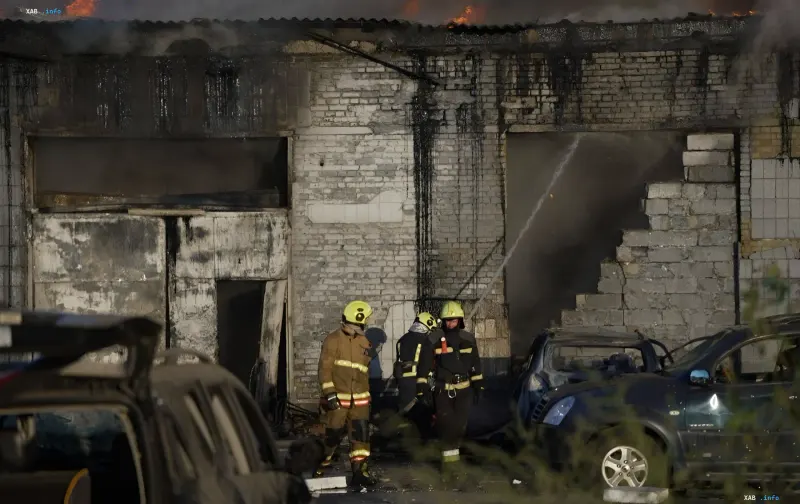
Work to eliminate the aftermath of a massive Russian strike continues through the night in Kyiv and the Kyiv region, as well as in a number of other regions of Ukraine. According to Ukrainian President Volodymyr Zelensky, the attack was of a combined nature and was designed to cause as much damage as possible to human lives and civilian infrastructure. Significant damage to residential buildings and other facilities has been recorded in the capital, and emergency services are working at several addresses simultaneously.
Combined nature of the strike
In his address, the President of Ukraine listed the types of weapons used during the night operation: "The attack was complex, one that the Russians were trying to deliberately calculate for as much harm to life as possible: ballistic, cruise and anti-ship missiles, and reactive 'Shaheds'." According to him, it is precisely the combination of ballistic and cruise missiles with the massive use of drones that makes such strikes particularly dangerous for air defense systems and for the population.
Casualties and destruction in the capital
As of the time the reports were published, ten people were known to be injured; all who need it are receiving medical care. Rescuers from the State Emergency Service managed to save thirteen people, two of whom died. The aftermath of the night strike has been recorded in seven districts of Kyiv: at least 14 high-rise buildings were damaged, along with a school, a polyclinic, a supermarket and a gas station. The Kyiv City Prosecutor's Office has opened a criminal case on the grounds of a war crime.
Strikes on other regions
In the Kyiv region, according to the President, the occupiers struck critical infrastructure facilities. In the Odesa region, an ordinary market was hit. In Kharkiv, two people were injured and an apartment building was damaged. In the morning, a locomotive of the Kyiv — Sumy train was attacked at a railway station in the Sumy region, with no casualties; the evacuation of people is ongoing. Strikes on Zaporizhzhia and the Dnipro region have also been recorded.
Wave of attacks: 1 and 2 September
The night strike comes against the backdrop of an ongoing wave of shelling: on 1 September Kyiv experienced an even larger-scale attack, during which, according to reports, there were many killed and injured, and homes and enterprises were damaged. On 2 September a Russian drone hit a university in Kyiv — at the time of the attack, about 160 students were in a shelter; significant destruction has been recorded at the National University of Food Technologies. The day before, in the Boryspil district, drones destroyed seven trucks and hit one logistics complex twice.
Contradictory data
The materials presented contain inconsistencies that are important to take into account. First, the exact date of the night strike under discussion is not explicitly fixed in the original text: it is described as current, while 1 September is mentioned as an "even larger-scale" attack, and 2 September as the day of the strike on the university, which blurs the chronology. Second, the casualty figures differ depending on the event: for the night strike, at the time of the report, two killed and ten injured were named, whereas for the 1 September attack, sources speak of "many killed and injured." These data relate to different episodes and are not summed up, but at the time of publication all figures are preliminary and may be refined.
Concluding his address, Volodymyr Zelensky thanked the partners who define aid to Ukraine in the form of air defense systems as a priority: "This directly means saving people's lives."