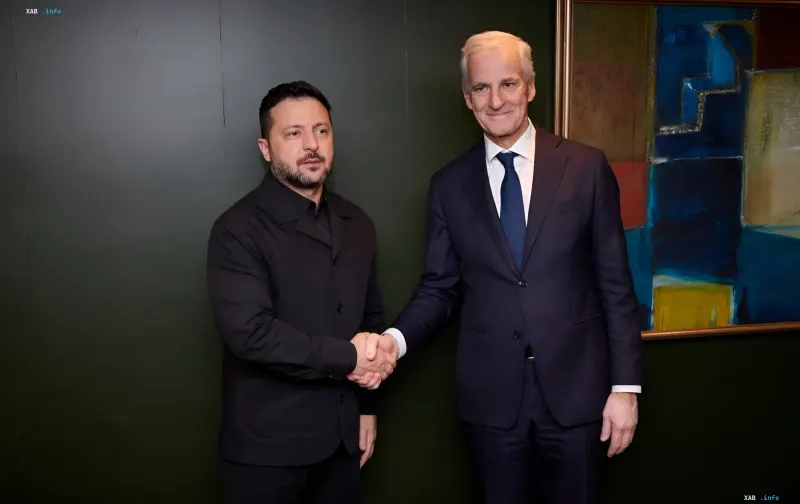
A working meeting was held in Oslo between Ukrainian President Volodymyr Zelensky and Norwegian Prime Minister Jonas Gahr Støre. This is reported by RBC-Ukraine, citing the official website of the head of the Ukrainian state. The negotiations focused on three blocks of issues: strengthening air defense, developing the joint anti-ballistic missile program FREYJA, and preparing Ukraine's energy infrastructure for the upcoming heating season. The meeting took place against the backdrop of an intensifying debate over the shortage of interceptor missiles for Patriot systems, which Zelensky publicly highlighted in August 2026.
Interceptor missiles and the PURL mechanism
First, the leaders discussed Ukraine's needs for interceptor missiles, primarily for Patriot air defense systems. Zelensky informed the Norwegian side about the current level of stockpiles and specific requirements. Ukraine is counting on Norway's support, including through the PURL (Presidential Ukraine Request List) mechanism, in which the kingdom is one of the leaders in terms of contribution volume. Context to understand the scale of the problem: as early as August 2026, Zelensky stated that for Ukraine to get through the winter it needed around 5% of the US stockpile of Patriot missiles, and CNN published footage of nearly empty launchers, after which the president acknowledged that at that time only 1% of the required number of interceptors remained.
The FREYJA anti-ballistic missile program
A separate item on the agenda was further work on the FREYJA program — a joint project to develop anti-ballistic missile defense. The sides summarized preliminary results and agreed on the next steps for implementing the initiative. The program envisages the integration of Ukrainian and European technologies to create a multi-layered system for intercepting ballistic targets, making it one of the key elements of Ukraine's long-term defense strategy within the framework of European defense cooperation.
Preparations for the heating season
The conversation also covered the practical preparation of Ukraine for winter. In the previous heating season, Norway had already provided significant energy assistance, and at the meeting the leaders discussed Ukraine's current needs and the kingdom's ability to support the country again. Given the damage to energy infrastructure as a result of Russian strikes, the issue of providing heat and electricity for millions of citizens remains one of the most vulnerable areas, where international support plays a critical role.
Condolences on the death of King Harald V
At the beginning of the meeting, Zelensky expressed condolences on the death of King Harald V of Norway. The President of Ukraine noted that it was important for him to be present in person at the farewell ceremony, scheduled for September 9 — the day after the meeting with the prime minister. Zelensky emphasized that Ukraine values the support of the Norwegian royal family and the entire Norwegian people, which has been maintained throughout the entire period of the conflict.
Broad defense context and the arrest of a Russian vessel
The meeting in Oslo fits into a broader cycle of defense agreements announced by Ukraine's partners on the eve of Independence Day. In particular, Norway and a number of other countries pledged to supply Gripen fighter jets, SCALP cruise missiles, and signed a drone agreement providing for the joint production of unmanned aerial vehicles. In parallel, a Russian vessel was arrested in Norway as part of the enforcement of an arbitral award on Naftogaz's claims worth $4.22 billion, demonstrating the use of Norwegian jurisdiction as a tool of economic pressure on Russia.
Contradictory data
In open sources citing Zelensky's statements on the level of Patriot missile stockpiles, various figures are recorded that can be misleading on a superficial reading. According to Euronews (August 13, 2026), the president stated that Ukraine needs 5% of the US stockpile of Patriot missiles to get through the winter. At the same time, the portal 1prime.ru (August 18, 2026) and glavred.info report that Zelensky acknowledged: at that time only 1% of the required number of interceptors remained. These indicators describe different metrics: 5% is the volume of need relative to the US arsenal, while 1% is the actual remainder in stockpiles relative to the required minimum. Nevertheless, in public discourse both figures are often cited as an "estimate of stockpiles," creating an impression of inconsistency. At the meeting in Oslo, specific numerical parameters were not disclosed, and the sides limited themselves to a general formulation about "needs for interceptor missiles."