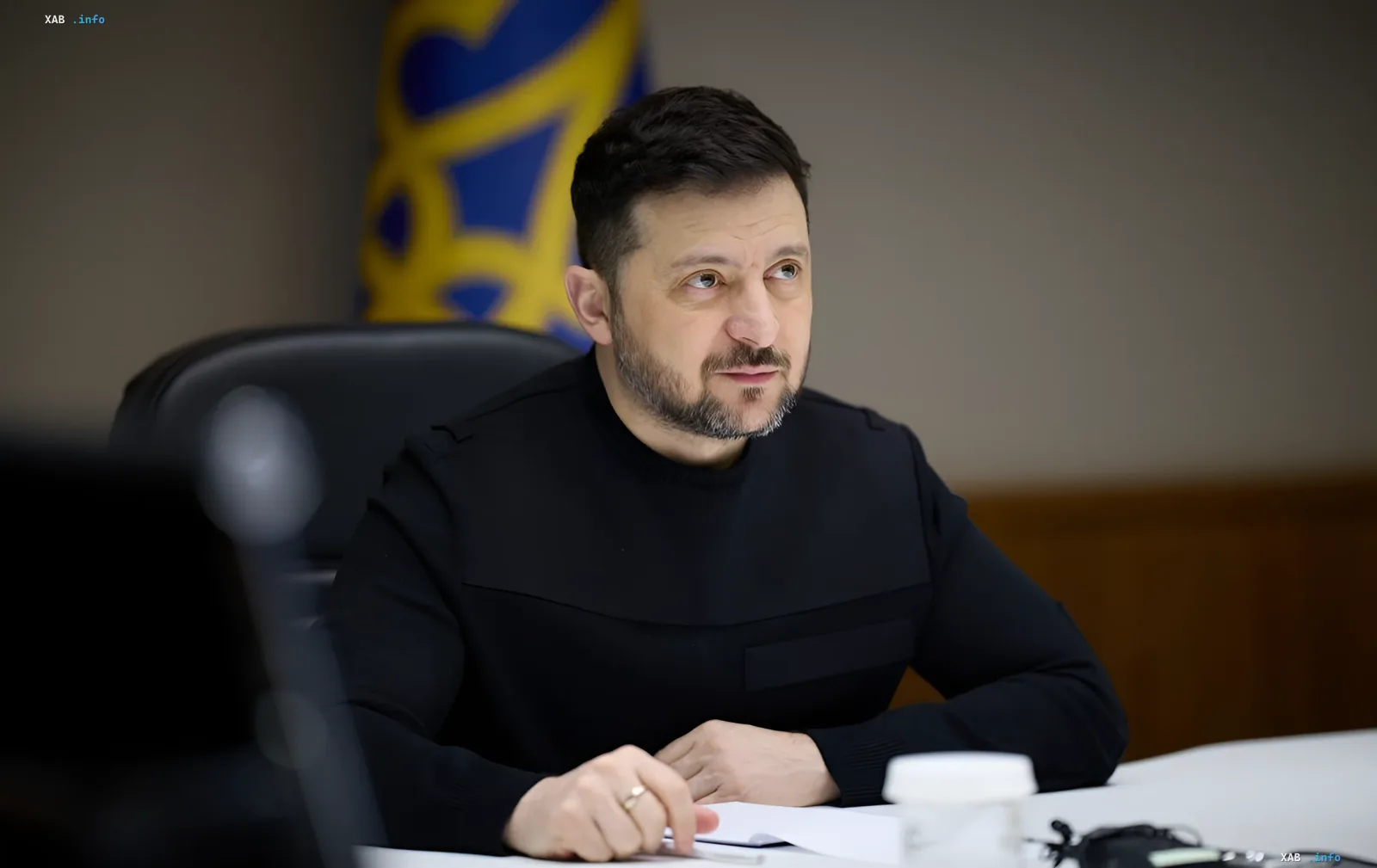
Ukrainian President Volodymyr Zelensky, at a meeting of the Supreme Commander-in-Chief's Staff (the Stavka), set before the domestic defense-industrial complex the task of significantly ramping up the production of unmanned aerial vehicles for long-range strikes on Russian territory. According to the head of state, the current average production rate stands at around 300 long-range drones per day, while the target benchmark is one thousand units daily. "The task: a thousand drones for long-range strikes a day against Russia; right now the average is 300, plus our long-range strikes. There must be more. We have a very specific goal, and we will accomplish this task," Zelensky declared, as reported by RBC-Ukraine citing his Telegram channel.
Target Metrics and the Logic of Scaling Up
The task set implies more than a threefold increase in the daily output of long-range UAVs compared to the current level. The president emphasized that systematic strikes by the Ukrainian Armed Forces on targets on Russian territory are already producing a tangible economic and logistical effect: in his words, Russia's reserves and export volumes of gasoline have shrunk, serious logistics problems have emerged, and Moscow has for the first time in history begun importing gasoline and is forced to spend budget funds to support oil companies. Zelensky added that the enemy's losses will grow even larger if Russia refuses to negotiate an end to the war.
Jet-Powered "Shaheds" and the Need for Interceptors
The head of state separately stressed the intensification of terrorist attacks by the Russian Federation, which, according to him, are increasingly carried out precisely by jet-powered modifications of the "Shahed" drones. Constant attacks have been recorded in Kyiv, Kharkiv, Zaporizhzhia, as well as in Sumy, Chernihiv, Dnipropetrovsk, Kherson, and Kyiv oblasts. "It is important that there be a significant acceleration in the production of interceptors, specifically against such jet-powered Shaheds, so that our strikes give Russia a greater sense of responsibility for the choice to continue this war," Zelensky stated. Thus, the ramp-up in long-range UAV production must be accompanied by a parallel increase in the output of air-defense systems.
The Strike on "Lukoil-Nizhnevartovsknefteorgsintez" as Context
The statement on plans to scale up long-range drone production came against the backdrop of a recent successful operation by the Armed Forces. On the night of August 26, 2026, Ukrainian forces struck one of Russia's largest oil refineries — "Lukoil-Nizhnevartovsknefteorgsintez" in the city of Kstovo, Nizhny Novgorod Oblast. On the same day, 16 military and infrastructure targets on Russian territory were hit, including refineries, airfields, and a missile unit. As a result of the drone attack, Russia's fourth-largest refinery completely halted crude oil processing due to damage to several units. The plant is the second-largest gasoline producer in the Russian Federation and is capable of processing around 15 million tons of oil per year.
Contradictory Data
When comparing various publications that reference the same Zelensky speech, a discrepancy in the figures for current production emerges. In the main body of the statement conveyed by RBC-Ukraine, the average rate is given as "300" long-range drones per day. However, in the headline of the Obozrevatel piece (Source ID 4), the wording reads "when a thousand drones, not a hundred, fly toward Moscow," implying a current level of 100 units. The difference may be linked to the fact that during the speech the president used different estimates (perhaps 100 for a separate category, 300 in aggregate), or to an imprecision in transmitting the quote. In addition, the original transcript of the Telegram channel contains clear errors in the automatic voice transcription: the word "strikes" is rendered as "sanctions," and "strikes" as "distraiki." The present article uses the correct terms.