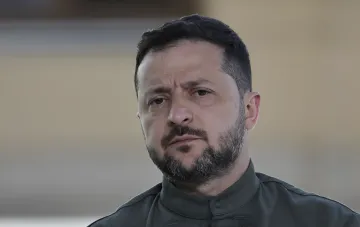
Following the completion of a humanitarian operation in Oleshky, Ukrainian President Volodymyr Zelenskyy has proposed a similar evacuation for residents of 15 other occupied settlements. According to him, people in each of these towns and villages are in dire need of food and are living without electricity, heating, water, or medical assistance. The proposal covers two regions: in the Kherson region, the list includes Radensk, Kostohryzove, Hola Prystan, Stara Zburivka, Nova Zburivka, Hladkivka, Velyki Kopani, Kardashynka, and Velyka Kardashynka; in the Zaporizhzhia region — Maiachka, Zlatopil, Dniprorudne, Kamianske, Verkhnia Krynytsia, and Vasylivka.
What is known about the situation in the Oleshky community
To understand the scale of the problem, the publication "Novaya-Europe" cites data on the Oleshky community, where a humanitarian mission recently took place. Before the full-scale invasion, about 38,500 people lived there, with nearly 20,000 of them in the city of Oleshky itself. Currently, according to the head of the Oleshky City Military Administration, Tetiana Hasaenko, approximately 4,500–5,000 people remain in the community, including about a thousand in the city, among them 20 children. The community includes 13 settlements, five of which, according to her, have been completely destroyed: Krynky, Pidstepne, Pishchanivka, Sahy, and Zaplava. In two of these five, according to the administration, there are still residents who "can be counted on the fingers of one hand" — there is no contact with them, they live in basements and rarely come to the surface to get water or food. Kozachi Laheri, Solontsi, and Pidlisne are about 80 percent destroyed.
Infrastructure and medicine: life on the front line
"Not a single high-rise building has survived [intact] in Oleshky," said Tetiana Hasaenko. "There is a complete absence of water supply, electricity, sewage, drinking water, and food supplies." The head of the community emphasized that it is located on the front line, where shelling and fighting occur daily, and the closer a settlement is to the water, the worse the safety of the residents. Medical assistance in the city is provided only in the hospital, but necessary medicines are not available there: "at best, doctors can stop bleeding." Pharmacies and social services are not working, there are no representatives of the occupation administration in Oleshky, and, according to Hasaenko, "people are left alone with their problems."
Humanitarian aid and prices on the 'road of death'
According to Hasaenko, food aid brought in during the humanitarian mission is reportedly stored in the hospital but is not being issued to residents: people who came for aid packages allegedly heard that the food was intended for those in the hospital. Animal volunteer Alla Lykhman-Malysh, who lives in Oleshky, said she managed to receive a humanitarian package once, which included a bottle of vegetable oil, a kilogram of sugar, two kilograms of flour, 800 grams of wheat groats, 400 grams of oatmeal, three packs of instant noodles, tea, a can of stew, two cans of sprat with beans, a can of condensed milk, 500 grams of pasta, and 400 grams of vermicelli. According to her, "the promised manna never reached the residents — not in the form of free access to food and medicine, and certainly not fuel or even firewood." Residents are surviving on their own: locals bring products from Radensk along a dangerous road. According to her data, a liter of milk costs 600 rubles, a gas cylinder — 19,000 rubles, vegetables — about 500 rubles per kilogram, meat — 2,500 rubles per kilogram, a loaf of bread — 250 rubles, and grains — about 1,000 rubles; animal feed, according to her, has never been delivered.
Why people cannot leave on their own and how the route will change
A number of residents, according to the publication, are not leaving the settlements due to the risk of shelling, lack of transport, and the need to care for loved ones and animals. Lykhman-Malysh, who came under fire while trying to bring food from Radensk shortly before the ceasefire, wanted to leave and take her pets: she was promised support, but later they refused to take all the animals for which she had prepared cages. She could not abandon her pets and remained in Oleshky. The publication also notes that after the damage to the Crimean Bridge, logistics are changing: the new evacuation route will take this factor into account, which, according to the authors, complicates the already risky movements in the combat zone.