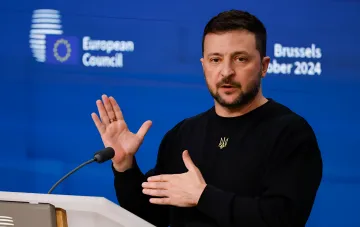
Ukrainian President Volodymyr Zelenskyy told journalists that the Ukrainian side tested the operation of Starlink terminals in the European Union and found significant differences in their performance compared to Ukrainian territory. According to the head of state, the test results lead to the conclusion that the restriction of satellite communications in Ukraine is part of a targeted, 'planned operation.' This was reported by RBC-Ukraine, citing Zelenskyy's direct statement.
Why Ukraine Needs Starlink: From Water Delivery to Intercepting Shaheds
Zelenskyy emphasized the critical importance of Starlink satellite communications for Ukraine, noting that it is used by both frontline military personnel and civilian users. In particular, using drones equipped with Starlink terminals, Ukrainian soldiers are able to deliver food and water to positions where ground vehicles cannot reach. The president also specifically highlighted the use of terminals in interceptor drones designed to combat jet-powered Shaheds and other high-speed unmanned aerial vehicles. These very drones, he said, suffer the most from the current restrictions.
The 161 km/h Threshold: When the Operator Loses the Drone
According to Zelenskyy, due to speed restrictions, interceptor drones cannot fully perform their tasks. When a drone accelerates to 161 km/h, the Starlink terminal disconnects, and operators lose contact with the device. This makes it impossible to use Starlink or Starshield to shoot down jet Shaheds on Ukrainian territory. The president concluded that Ukraine currently lacks this capability.
EU Test: 180 km/h Without Glitches
To determine whether the problems were related to technical malfunctions of SpaceX equipment or if targeted restrictions were in place, the Ukrainian side conducted a control test in EU countries. 'We sent a couple of cars with Starlink to the territory of EU countries, and they drove at a speed of 180 km/h, and Starlink works,' Zelenskyy explained. According to him, the test results indicate that the restrictions apply exclusively to the territory of Ukraine. 'The conclusion is that the restrictions are in effect on the territory of Ukraine, meaning this is a planned operation,' the president added.
Negotiations Without Answers: Military, Ministry of Defense, and Diplomats
Zelenskyy stated that the Ukrainian side is conducting negotiations at various levels: the military, the Ministry of Defense, and diplomats are involved in the process. Ukraine is also trying to contact SpaceX directly. However, as the president noted, Ukrainian military and Ministry of Defense representatives have not yet received an answer. 'At various levels, they say these are technical problems, but as I said, these problems exist in Ukraine; on the territory of the EU, these problems do not exist. We checked this,' he stressed.
Who Made the Decision: Conflicting Statements
The restriction on the military version of Starshield satellite communications became known on October 14, 2026, when terminals on Ukrainian drones began losing connection at speeds exceeding 160 km/h. On the same day, the Ministry of Defense of Ukraine launched negotiations with the US, SpaceX, and NATO partners. Elon Musk stated that the speed limit for Starshield is determined by the US military, and the final decision depends on the US President. Meanwhile, the White House denied the Donald Trump administration's involvement in the restrictions, and Trump himself also stated he had was not involved. However, according to The Telegraph, Elon Musk himself proposed to Donald Trump that the speed of the military version of Starlink for Ukraine be restricted. Four sources of the publication claim that the US President agreed with this proposal and gave the 'green light' to the Pentagon. This version was also confirmed by a European official and two Ukrainian sources.