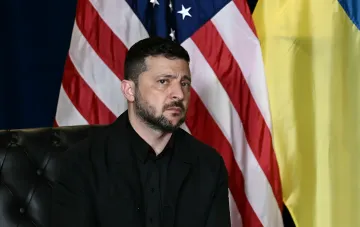
Ukrainian President Volodymyr Zelenskyy told Bloomberg that Kyiv will push Washington for a significant increase in military aid and tougher sanctions against Russia if a peace agreement acceptable to Ukraine is not reached by the end of 2026. According to him, "a level of support for Ukraine and sanctions that serve as a clear signal to the Russians is necessary," and it is also "time to sit down at the negotiating table and put an end to the war." The interview was published late Monday, November 23, 2026.
Appeal to the Incoming U.S. Congress
Zelenskyy stated his intention to appeal to the incoming U.S. Congress, where Democrats will hold the majority following the midterm elections. He noted that Kyiv will urge lawmakers to increase pressure on Moscow if U.S. President Donald Trump fails to convince Kremlin leader Vladimir Putin to end the war by the end of 2026. In doing so, Ukraine is setting up a scenario where the shift in the American parliament in early January 2027 becomes a turning point in Washington's policy toward the conflict.
Demands for Concessions and Moscow's Stance
The Ukrainian president pointed out that U.S. special envoys Jared Kushner and Steven Witkoff are pushing for a peace deal "as soon as possible," ideally by early January. However, Zelenskyy noted that Ukraine is facing demands for significant concessions, while Putin shows no signs of readiness to end the war. "We understand what the price might be. We also really want peace, but not at the expense of Ukraine alone," he stressed. This statement reaffirms Kyiv's position: while open to compromise, Ukraine insists on reciprocity.
Security Guarantees and NATO Membership
Citing previously published data from The Washington Post, Bloomberg reports that Putin has privately agreed to allow the U.S. and Europe to provide Ukraine with security guarantees modeled on Article 5 of the North Atlantic Treaty, under which an attack on one alliance member is considered an attack on all. Zelenskyy does not rule out such an option but remains skeptical about its practical efficacy. He maintains that Ukraine needs firm commitments from Western allies for reliable military support and stricter sanctions in the event of a new Russian invasion, and he views full, unconditional NATO membership as a more realistic solution. "If Putin believes Ukraine is preparing for military revenge, he should be the one most interested in our NATO accession," the president said, adding that otherwise, Kyiv would not be able to reclaim occupied territories by force and would "lose all our partners."
Blocking Patriot Missile Shipments
According to the Financial Times, U.S. Secretary of Defense Pete Hegseth has yet to approve the transfer of approximately 60 Patriot surface-to-air missiles to Ukraine, a shipment previously agreed upon by Washington. These munitions include U.S.-made PAC-3 and PAC-2 missiles, some of which are held in European warehouses, with their purchase funded by Kyiv's Western allies, the newspaper reported on November 24, citing sources. The delivery of PAC-3 missiles was scheduled for September–December, but no batch has received Pentagon approval for shipment. Furthermore, while Washington agreed to provide an additional 20 older-model PAC-2 missiles, that shipment also remains unapproved.
Political Context and Timelines in the U.S.
Three days earlier, the FT, citing four informed sources, reported that the Trump administration is striving to secure a peace deal between Kyiv and Moscow by the end of 2026, as Democrats will gain control of both houses of Congress in early January, significantly curbing Republican influence. According to one European source, the Americans are "pushing hard," and there are "concerns" that Ukraine "may have to make serious concessions." These statements suggest that the coming weeks will be decisive in determining the trajectory of negotiations and the scope of U.S. support for Kyiv.