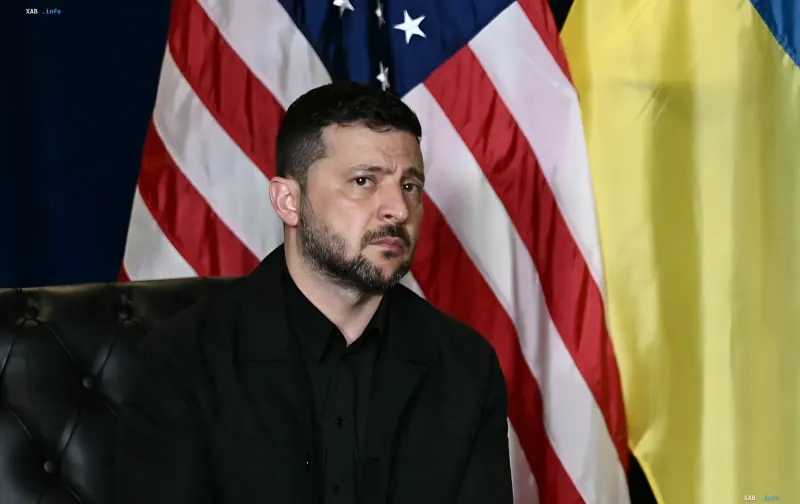
Ukrainian President Volodymyr Zelenskyy, in an interview with the PBS NewsHour program, provided an extensive assessment of the current relations between Kyiv and Washington, which he described as remaining "difficult." Standing against the backdrop of Ukrainian and U.S. flags, the head of state urged the American administration to redirect the vector of pressure: instead of demanding concessions from Kyiv, Washington should increase sanctions and political pressure on Moscow, which he asserts is the aggressor side in the ongoing conflict. The interview became one of the most candid public statements by Zelenskyy regarding the state of bilateral relations, against a backdrop of a series of controversial decisions by the American administration in recent months.
Pragmatism Instead of Emotion: How Zelenskyy Described Relations with Trump
The PBS NewsHour journalist asked the Ukrainian president to briefly characterize his current relationship with the American leader. Zelenskyy replied that in wartime, a pragmatic approach is key: parties must move away from emotional assessments and rely on concrete interests. At the same time, he emphasized that in any dialogue, one cannot forget who started the invasion, and that responsibility for the aggression lies with the Russian leader Vladimir Putin, whom Zelenskyy called a "dictator." Such wording in a public interview with an American television channel became one of the sharpest public statements by the Ukrainian president toward the Russian leadership in recent times.
'Not Me, but Putin': A Call to Change the Direction of Pressure
Concluding his position, Zelenskyy addressed the U.S. administration with a direct appeal to change the direction of diplomatic and economic pressure. "It is better to pressure Putin, not me. Not me. I am not the aggressor," he declared. According to him, it was Russia that started the war, so responsibility for its continuation should not be shifted to Ukraine. This statement resonates with earlier remarks by Zelenskyy in an interview with NBC Meet the Press, where he also expressed hope that Trump would reconsider a number of recent decisions and change his approach to Putin, emphasizing that Kyiv still wants to trust the United States and expects the preservation of allied relations.
Skepticism Regarding the Russian Diesel Fuel Deal
Separately, the head of state commented on U.S. agreements regarding the purchase of Russian diesel fuel. Zelenskyy doubted that such an agreement would have the promised impact on prices in the American fuel market. In the context of broader criticism expressed in the NBC interview, the Ukrainian president pointed out that the aggregate of Washington's decisions—from the temporary cessation of some intelligence data transfers to restrictions on Starlink and Starshield satellite communications and the easing of sanctions pressure—creates the impression in Moscow that it is receiving political and economic concessions without stopping hostilities. The diesel fuel deal, in his view, fits into this logic and does not carry any real economic effect for consumers in the U.S.
'We Are Defending Europe, Not Just Ourselves': The Argument About U.S. Pragmatic Interests
Zelenskyy also emphasized that supporting Ukraine serves the pragmatic interests of the United States itself. According to him, the Ukrainian army must remain strong, because otherwise Russia could continue its advance into Europe and approach the borders of NATO countries. "If we are talking about pragmatic things, we must support Ukraine because it must be strong. Otherwise, Putin will go further into Europe and into different parts of NATO countries. And in these cases, America will have to decide different things, it is very dangerous. It is better to make Ukraine stronger because we are defending Europe, not just ourselves," the president stated. This argument became central to his appeal to the American audience: Kyiv, according to his logic, acts as a buffer, whose weakening ultimately creates additional risks and expenses for Washington.
Context: Intelligence, Starlink, and the Energy Truce
The PBS interview did not occur in a vacuum. As reported by DW, on October 13, 2026, Zelenskyy stated that before the strike of five ballistic missiles on Kyiv's infrastructure on October 12, partners did not provide Ukraine with a warning and intelligence data. "Intelligence data on the launch of Russian ballistic missiles helps to save people's lives, and this is one of the most critical issues," he wrote on Telegram. At the same time, Ukrainian forces did not strike Russian oil refineries for two days after Trump announced a ceasefire in the energy sector, whereas the Russian Armed Forces, according to Zelenskyy, continued to attack Ukrainian energy facilities. These circumstances form the background against which the statements on PBS NewsHour sound like an attempt to publicly register the discrepancy between Kyiv's expectations and Washington's actual actions.