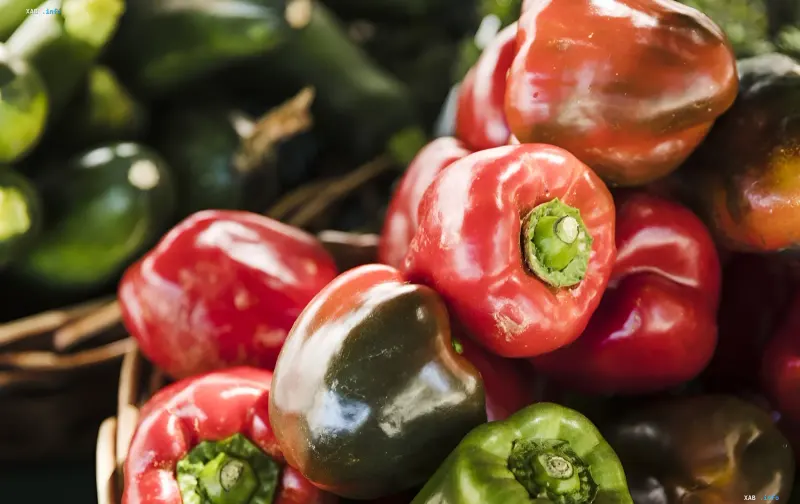
End of August and early autumn are the times when gardeners face the same annoying problem: sweet pepper bushes are laden with large fruits, but they stubbornly remain green, despite promises of a harvest. Many are used to picking such peppers and leaving them to ripen on the windowsill, however, in this case, they lose the signature sweetness and juiciness that form specifically on the plant under the sun. According to the Styler project (RBC-Ukraine), experienced agronomists know a simple trick that takes only a few seconds but forces the bush to devote all its accumulated strength to the ripening of already formed fruits.
Why peppers get "stuck" in green
The main reason why peppers take a long time to change color lies in the biology of the plant: the bush continues to spend energy on the growth of vegetative mass, flowering, and the formation of new ovaries. The plant essentially "does not understand" that summer is ending and does not switch to the ripening mode. The gardener's task is to create controlled stress for it and redirect the flow of nutrients to those fruits that have already formed and are capable of turning red before the cold sets in.
Pinching growth points: the main trick
The key procedure is called pinching the growth points and takes no more than ten seconds per bush. It is necessary to inspect the tops of the branches and find all new flowers, tiny ovaries that will definitely not have time to ripen before the frosts, as well as young shoots on the tops. They should be ruthlessly pinched off with fingers or cut with garden shears. As soon as the apical growth points are removed, the bush stops growing foliage and new inflorescences, and all water, potassium, phosphorus, and solar energy rush to the large green fruits. Just a few days after the manipulation, the peppers begin to turn red, yellow, or orange in bulk right in the garden bed.
Removing lower leaves for light access
The second important step is to break off the leaves on the stem up to the first fork. This improves ventilation of the root zone and exposes the fruits to direct sunlight, which additionally accelerates the accumulation of carotenoids and sugars. The combination of these two simple actions — pinching the tops and thinning the lower part — creates that very "artificial stress," after which the plant stops growing itself and begins to ripen the harvest.
Contradictory data
It should be noted that there are discrepancies in the assessment of pruning in agricultural recommendations. On the one hand, Styler and a number of publications (including pravda.ru) directly advise pinching growth points and removing lower leaves as a way to accelerate coloring. On the other hand, a publication by belnovosti.by warns that it is precisely three August mistakes — including incorrect or premature removal of leaves and side shoots, as well as violations of watering and fertilizing — that can leave the pepper green and thin-walled until October. Thus, some sources interpret pinching as a mandatory stimulator of coloring, while others warn it as a risky intervention that, with incorrect timing, only exhausts the bush. The difference, in essence, boils down to the timing and degree of intervention: one should only pinch those ovaries and shoots that objectively will not have time to ripen, without completely stripping the bush.
Practical conclusions for the gardener
The combination of sources allows formulating a working algorithm for the end of summer: assess which fruits are already formed and capable of turning red before the cold; carefully remove apical growth points with small ovaries and new flowers; thin out the lower leaves up to the first fork for light and air; do not overdo it with pruning so as not to deprive the bush of photosynthetic mass. With this approach, peppers that have remained green for weeks begin to change color within a few days, retaining the sweetness and juiciness unattainable when ripening on the windowsill.