In the context of a protracted conflict, where personnel losses have become a key factor in an army's sustainability, Ukrainian military personnel are increasingly transferring routine and the most dangerous tasks to machines. This was explained in a fresh column for LB.ua by Major Ihor Bohdan, head of the Innovation and Technology Center of the 7th Rapid Reaction Corps of the Rapid Reaction Command (DSHV). According to him, the corps has built a clear model of technological warfare in which the human is taken out of the zone of direct risk as much as possible, and the combat process relies on a closed loop: sensor — information — decision — engagement — analysis — modernization. It is precisely this logic, Bohdan claims, that determines the day-to-day work of the corps' units at the front line.
Five principles underpinning "technological warfare"
Bohdan highlights five basic principles on which the combat work of the 7th DSHV Corps is built: the mass application of technical means, decentralized command, the integration of heterogeneous platforms into a single system, constant adaptation to the enemy's tactics and, crucially, the maximum removal of the human from the risk zone. "Every task that can be handed over to a machine, a sensor, a UAV or a ground robotic complex, we must try to hand over to a machine. Technology is, first and foremost, a way to preserve the service member," the major emphasized. This approach turns technological superiority from an abstract metric into a concrete tool for reducing casualties.
From StabX to "Yadro": the arsenal of the Innovation Center's projects
At present, the Innovation and Technology Center of the 7th Corps is working on a number of projects, each of which addresses a specific pain point in the combat process. Among them are the visual positioning systems StabX and Cyclops, which allow drones to operate in a complex navigation environment where the GPS signal may be jammed or distorted. The Dron Cell system is aimed at increasing the flight time and range of FPV drones, which is critical for engaging targets on distant lines. Communication projects are also highlighted separately: the LTE network "Yadro" and the Mesh network, which combine various platforms into a single information environment, as well as the research project Ubrain. In essence, this is about creating a "digital framework" within which each element — from a drone to a radar — receives data and passes it on without loss of speed or accuracy.
"Kvadro": the ground robot visible in the photo
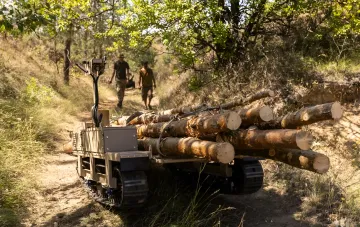
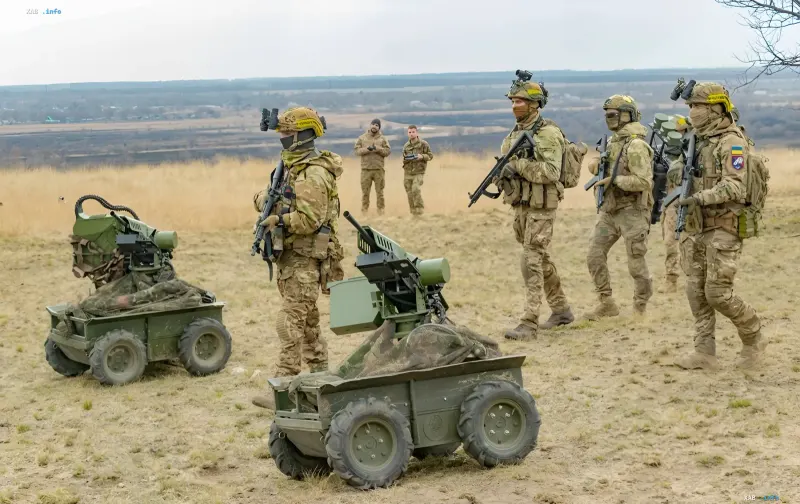
Among the most tangible developments, Bohdan named the ground robotic complex "Kvadro." In the published footage, it can be seen as a four-wheeled olive-colored platform with a weapon mounted on it — an automatic machine gun or a light cannon, protected by an armored shroud. According to the military, "Kvadro" is a "standard platform that we are reworking into a remotely controlled one and gradually integrating into the overall communication system." The photos also show the corps' service members in camouflage uniforms with AFU shoulder insignia, armed with rifles and equipped with tactical helmets featuring navigation modules. They accompany the robotic complexes in field conditions, demonstrating a hybrid model in which the human and the machine act as a single combat unit.
The main advantage is not the hardware, but the speed of iterations
At the same time, as Bohdan emphasizes, the main technological advantage of the 7th Corps lies not in an individual drone, radar or robot, but in the ability to find solutions faster than the enemy, test them in combat conditions, modernize and scale them. "Our goal is simple: to fight with technology in order to save as many people as possible," the head of the Innovation Center summed up. This formulation reflects a paradigm shift: effectiveness is measured not by the amount of equipment in the warehouse, but by the speed of the "detected — decided — engaged — analyzed — improved" cycle. In the context of the statements by the Deputy Speaker of the Verkhovna Rada, Konstantyn Kondratyuk, that the 7th DSHV Corps "looks the way the modern army of Ukraine should look," the corps' approach acquires not only tactical but also strategic significance as a benchmark for the entire AFU.
Contradictory data
The provided sources show no significant discrepancies in facts and figures. Bohdan's column for LB.ua (published on September 2, 2026) and the RBC-Ukraine retelling (linking to the same material) carry identical content. The only caveat: in the column, "Kvadro" is described as a "standard platform," which may give the reader the impression of a serial product, whereas the footage shows that the complex is still in the stage of refinement and integration into the overall communication system. Thus, the public presentation somewhat outpaces the actual readiness of the platform for serial application, although the fact of its combat use is confirmed.