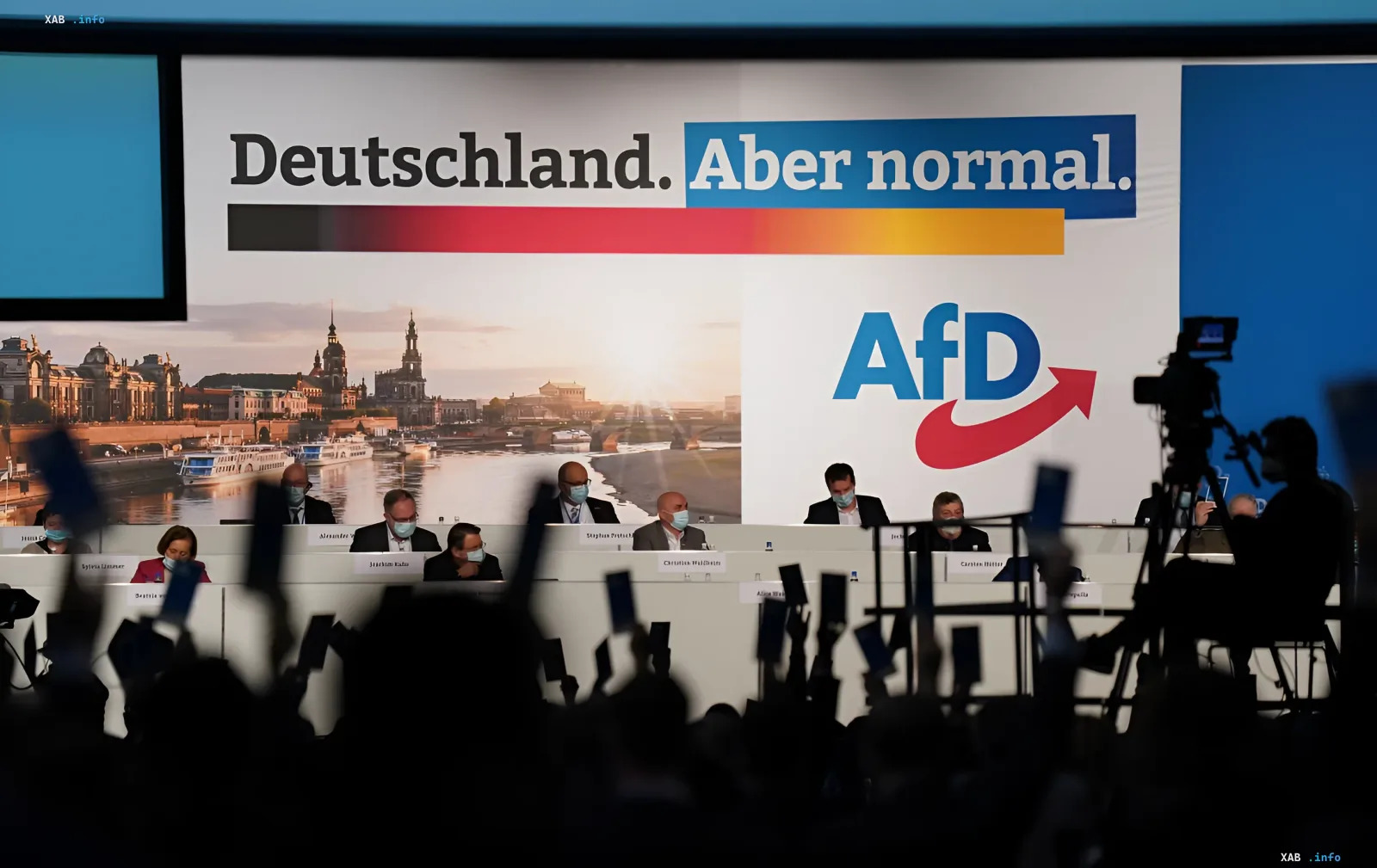
The completion of voting in the state elections in Mecklenburg-Vorpommern and Berlin on 21 September 2026 turned into one of the sharpest shocks for the German political system in recent years. The first exit polls, published immediately after the polling stations closed, recorded the lead of the far-right Alternative for Germany (AfD) in Mecklenburg-Vorpommern and a convincing second place for the same party in Berlin. This is already the AfD's second consecutive victory in state elections — on 7 September the party triumphed in Saxony-Anhalt, and now, according to preliminary data, it is consolidating its success in two more federal states.
Mecklenburg-Vorpommern: AfD at 37%, CDU on the brink
According to the first forecasts voiced by television channels immediately after the polls closed, in Mecklenburg-Vorpommern the Alternative for Germany is polling around 37% of the vote. In second place is the Social Democratic Party of Germany (SPD) with 35.5%. A significant gap of 1.5 percentage points between the two leaders makes forming a coalition an extremely difficult task. They are followed by The Left with 7.5%, while the Greens and the Christian Democratic Union (CDU) each receive 5.5% of the vote. Thus, according to preliminary exit poll data, the CDU is on the very brink of clearing the five-percent threshold into the state parliament — with the slightest fluctuation in the final figure, the Chancellor's party may not win a single mandate.
Berlin: The Left lead, AfD in second place
In Germany's capital the picture is different but no less telling. According to the first forecasts, the lead in Berlin is held by The Left, for whom 24.5% of voters are ready to vote. The Christian Democratic Union takes second place with 20%, while the AfD polls 16%. The Greens receive 15%, and the SPD only 12%. Such a distribution has not been seen in Berlin politics for many years: the social democrats, who traditionally dominated the capital, have dropped to fifth place, while the far-right party has entered the top three in Berlin elections for the first time.
Contradictory data
Between the preliminary exit poll figures and subsequent media reports, a noticeable discrepancy has emerged in the assessment of the CDU's results in Mecklenburg-Vorpommern. In the initial data voiced immediately after the polls closed, the Chancellor's party appears with a result of 5.5% — formally above the five-percent threshold. However, a number of Ukrainian and international publications, citing refined counting data, report that the CDU failed to enter the state parliament, falling short of the threshold by just 0.1 percentage points. If this version is confirmed by the final count, it will be the first case in the post-war history of the Federal Republic of Germany when the CDU is not represented in a state parliament. The final results will only be known after the full count of votes, and it is they that will resolve or confirm this contradiction.
Merz calls the results a 'catastrophe' and warns of consequences
The Chancellor of Germany, Friedrich Merz, publicly reacted to the exit poll results. He emotionally called them a 'catastrophe' for his political force — the CDU — and acknowledged that such a development of events is a 'serious shock for Germany'. At the same time, the Chancellor stated that he is determined to continue the reforms he is carrying out as long as he remains in office. Merz expressed particular concern in the context of foreign policy: he warned that the systematic growth in the AfD's electoral indicators could affect support for Ukraine and the overall policy of the West. According to the German leader, the unexpected and consistent victory of the far-right party would 'please the team of Russian dictator Vladimir Putin'.
Expert view: what this means for Ukraine
Former Ukrainian Consul in Munich and Chancellor of the Ukrainian Free University Dmytro Shevchenko, in his commentary, noted that the AfD's victory in local elections could over time affect the volume and nature of aid to Ukraine and to Ukrainian citizens living in Germany. The expert pointed out that the systematic strengthening of the far-right at the regional level creates a long-term risk for the European security architecture and for Berlin's position in supporting Kyiv. Against the backdrop of the AfD already having won in three states in less than a month (Saxony-Anhalt, Mecklenburg-Vorpommern and potentially Berlin), the question of how these results will reflect on federal politics and on the NATO alliance is becoming increasingly acute.
The final results of the elections in both states will be published after the full count of votes. For the German political system, the key will be whether the CDU manages to retain its presence in the Mecklenburg parliament and how the coalition arithmetic will be constructed in both states, where the AfD is vying for the role of a decisive factor in forming power.