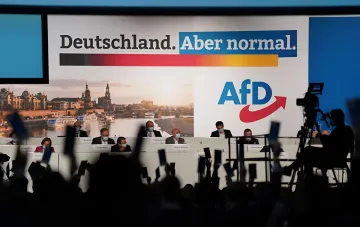
In the parliamentary elections held on 20 September 2026 in the federal state of Mecklenburg-Vorpommern, the far-right Alternative for Germany (AfD) party scored a decisive victory. According to figures that remain unofficial at the time of writing due to ongoing vote counting, AfD took first place, polling roughly 33–38% of the vote. On the same day, local parliamentary elections were held in Berlin, where, according to forecasts, the Left Party leads with approximately a quarter of the vote. Thus, the results of the two ballots complete a series of elections in the eastern part of the country directly tied to the political future of Federal Chancellor Friedrich Merz.
Results in Mecklenburg and Berlin
Preliminary data puts the Social Democrats in second place in Mecklenburg-Vorpommern. The Left Party and the Greens cleared the five-percent threshold, while Merz's conservative party (CDU/CSU) and the left-populist alliance led by Sarah Wagenknecht are hovering on the brink of entering parliament. The picture in Berlin is different: the Left Party leads, Merz's conservatives come second, and the far-right AfD takes only third place with roughly 16% of the vote. Wagenknecht's alliance is not expected to make it into the Berlin parliament.
Contradictory Data
It is important to stress that, at the time of publication, the figures remain unstable. Different sources cite a different range for the AfD — from 33% to 38% — due to the unofficial stage of the count. At the same time, some materials report that the Social Democrats polled around 35%, which creates an inconsistency: with such a figure the gap between first and second place becomes minimal, and in some interpretations second place could end up above the lower bound of the AfD's result. Until the official count is completed and the final protocols are published, these discrepancies should be treated as preliminary, and the final balance of power may shift.
Context: AfD Victory in Saxony-Anhalt
The current elections are a continuation of a series of votes in eastern Germany. Two weeks earlier, on 7 September, the AfD scored a decisive victory in the Saxony-Anhalt elections, polling nearly 44% of the vote, while the conservatives lost almost half their support compared with the previous elections. In Merz's own words, such a development is a serious shock for Germany. The Chancellor also warned that the result could affect support for Ukraine and Western policy as a whole, noting that the unexpected AfD victory would please the team of Russian dictator Vladimir Putin.
Threat to the Chancellorship and the Search for a Successor
Against the backdrop of the results in the two states, the media are already discussing a possible replacement of Merz with another politician without holding snap elections. On the evening of voting day, the Chancellor convened the party leadership to ask them directly whether they still support him in his post. Among the possible successors, the head of the federal state with the largest population is most often named. Experts stress that the series of eastern elections has effectively become a stress test for Berlin's coalition course and may reshape the balance of power in the Bundestag in the medium term.
The View from Ukraine
The consequences of these elections are also being assessed in the Ukrainian expert community. Dmitry Shevchenko, former Ukrainian Consul in Munich and Chancellor of the Ukrainian Free University, noted that the AfD's victory in local elections could, over time, affect aid to Ukraine and the position of Ukrainian compatriots in Germany. Thus, the domestic political crisis in the Federal Republic of Germany is acquiring a foreign-policy dimension that will be closely watched in the coming months.