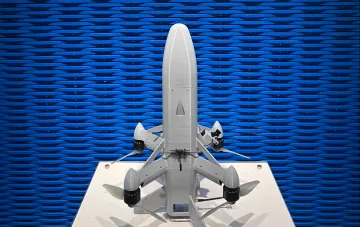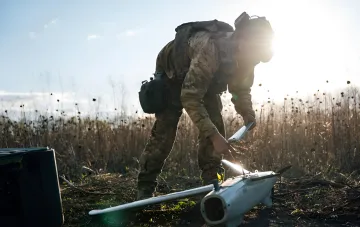
Soldier and former Member of Parliament Egor Firsov, in an interview with the RBC-Ukraine project “Don’t Interrupt!” with Volodymyr Kurennyi, stated that within a year or two, Ukraine will start applying autonomy and artificial intelligence more actively, and in three to five years, the nature of combat will change so much that the side that masters these technologies first will gain a significant advantage. According to him, the development of unmanned systems cannot be viewed in isolation from AI: if algorithms can create a presentation design or analyze a financial spreadsheet in seconds, they can also process data in the military sphere. At the same time, Firsov emphasized, the AI does not necessarily have to fire weapons itself—its role lies in decrypting information, detecting the enemy, identifying targets, and analyzing the use of drones.
Ten million drones as a single database
The expert cited the volume of accumulated data as a key argument for the rapid adoption of AI. According to him, Ukraine has produced nearly 10 million drones, and each generates information: one hit a target, another missed, a third destroyed equipment. This mass, by Firsov’s estimate, can be systematically analyzed by artificial intelligence, turning scattered results into actionable knowledge about tactics and weapons effectiveness. Such analytics, according to his logic, will become the foundation for autonomous decision-making on the battlefield.
Comparison to the creation of the atomic bomb
Firsov compared the current situation to the moment of creating nuclear weapons: a persistent trend is emerging where the battlefield will be partly managed by AI. He stressed that this is “not a story about tomorrow or next month,” but also not a distant prospect—the window to gain an advantage is limited. In the Armed Forces of Ukraine, he says, such approaches are only just emerging, and in this initiative, the expert believes Ukraine is one step ahead of the Russian armed forces. The main thing, as he framed it, is not to lose direction and not to concede the initiative to the enemy.
What is already happening at the front
Describing the near future, Firsov speaks of a large number of drones, ground-based robotic complexes, and air systems not directly controlled by humans: operators will only set parameters, and the process will proceed autonomously. According to him, at a depth of approximately 15 kilometers from the conditional contact line, combat operations are already largely taking place with the participation of drones. However, a ground-based robotic complex moving along a road is still controlled by an operator, which highlights the transitional nature of the current phase.
International context: Geneva and the NATO competition
Firsov’s expert assessments coincide with the international background. In November, negotiations in Geneva on a mandate for a legally binding treaty on autonomous weapons ended without a result due to objections from Russia, RBC-Ukraine reported, citing The Guardian. Earlier, a Ukrainian development with an AI module for target acquisition took third place in the NATO Persistent Airfield Denial competition; according to the Ministry of Defense, the solution is designed to increase the autonomy and accuracy of strike systems. The combination of these facts indicates that the race for autonomous weapons has become one of the key areas of military-technical competition.