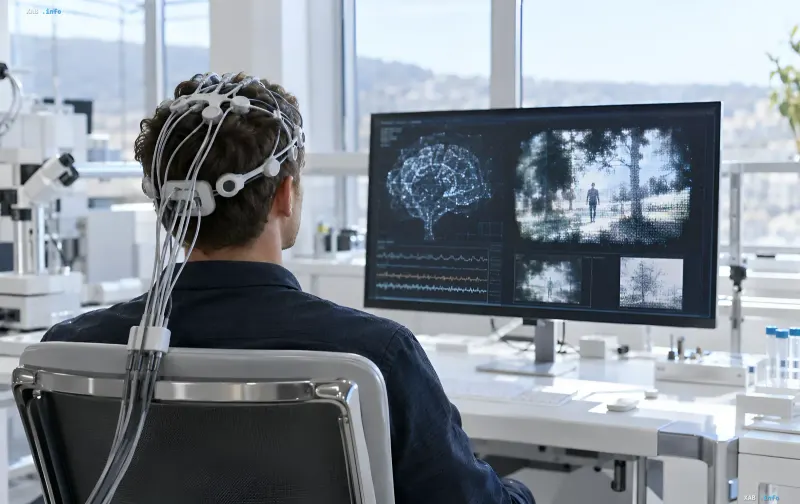
An international team of researchers from the US, Switzerland, and Spain has presented the results of an experiment in Neuron magazine, in which deep learning algorithms took over the control of human visual cortex electrical stimulation for the first time. During the trial, a 27-year-old man who lost his sight due to an injury was able to see flashes of light and object outlines — known as phosphenes — thanks to an AI-controlled implant. According to RBC-Ukraine, the technology makes it possible to form sharper visual images with lower energy consumption compared to previous bionic vision approaches.
How the Implant Works and What the Patient Sees
An array of 96 electrodes was temporarily implanted into the subject's visual cortex. The device delivers electrical impulses directly to the cortex, bypassing the damaged optic nerve. As a result, the patient perceives not a full picture, but individual flashes of light — phosphenes — from which, according to the developers, a complete image can eventually be assembled. During the trial sessions, the man described the characteristics of the flashes he saw: their brightness, size, shape, and color. This subjective data served as feedback for the neural network, allowing it to precisely adjust the parameters of further stimulation.
Brain Non-linearity: The Main Engineering Challenge
The key difficulty of the development, as the authors of the study emphasize, lies in the fact that the visual cortex reacts to electrical impulses non-linearly. Engineers aim to use each electrode as a 'pixel' on a virtual screen, but the brain is not a static display: its state is constantly changing, and neighboring electrodes interfere with each other, creating crosstalk. This is precisely why a fixed stimulation pattern calculated once does not work — the brain 'drifts' away from the set mode, and without continuous adaptation, image quality rapidly degrades.
The Role of AI: On-the-Fly Adaptation
This is where deep learning comes in. Artificial intelligence continuously analyzes the individual brain reactions of a specific person and adjusts stimulation parameters in real time. According to the researchers, a useful visual prosthesis cannot operate on a pre-set template: every brain is unique, and the algorithm must account for its current state, fatigue, attention, and other variables. Such an approach, the authors estimate, makes it possible to obtain sharper visual images with lower energy costs than with classical implant control methods.
Who the Technology Is For and What's Next
The developers emphasize that the technology will be a salvation for people who lost their vision in adulthood due to trauma, chronic diseases, or hereditary eye pathologies. At the current stage, the work is a successful proof of concept: it has confirmed that AI is capable of effectively managing the complex non-linear 'brain-implant' system and improving the quality of perceived images. Scientists point out that the results obtained will form the basis for future commercial bionic eyes, but significant work on miniaturization, implant durability, and expanding the number of electrodes to form a full image still lies ahead before a serial product and widespread clinical implementation, by their estimates.