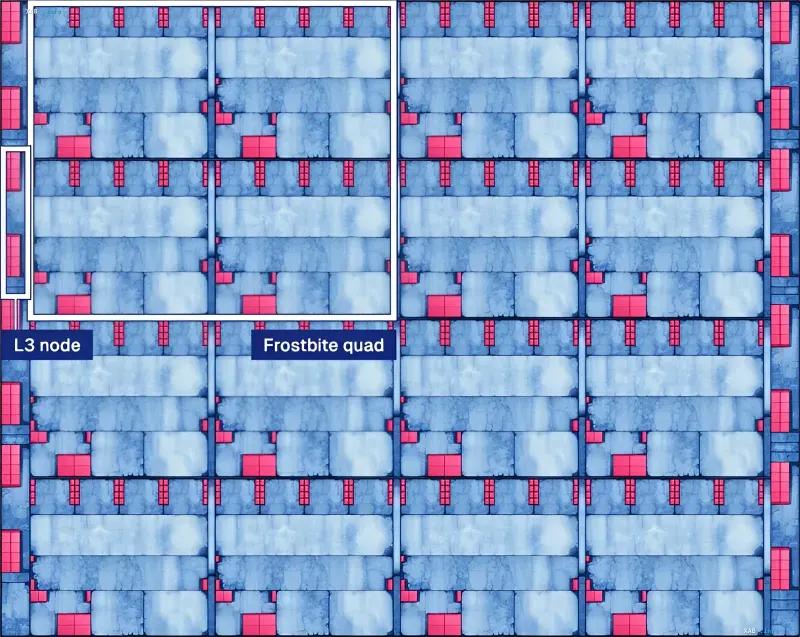
American startup Architect Labs has unveiled Frostbite, an experimental general-purpose processor architecture designed from scratch with the help of artificial intelligence. According to the company, the new architecture demonstrated an average 4.59x advantage in performance-per-watt across 25 test tasks compared to a "traditional processor core" from an unnamed company. The competitor's name, according to the developers, was kept secret for legal reasons. Frostbite consists of four basic blocks, each containing four compute tiles that exchange tasks via an integrated network.
Why modern CPUs have hit a wall
Modern general-purpose processors used in desktops and laptops are unthinkable without a multitude of architectural "crutches" dictated by legacy: the need to support an instruction set created long ago and to evolve the architecture without radically breaking the developments of past decades. According to the developers, these "vestiges of the past" do not just lower performance and increase power consumption — they consume them. An architecture built from scratch without commitments to legacy instructions allows for computational acceleration purely due to the absence of such constraints.
Interaction nets: a 1990 mathematical model at the core
The main feature of Frostbite is the use of a mathematical model of computation called interaction nets, proposed back in 1990. Unlike traditional processors, which are forced to determine dependencies between instructions and manage out-of-order execution, Frostbite operates with an explicit description of the links between operations. The program is represented as a graph of interacting nodes: each node has defined inputs and outputs, and computations occur via local transformation of connected pairs of nodes. A key property of the model is that each value has a single owner and is used exactly once. This reduces the need for shared mutable memory, complex cache coherence mechanisms, and centralized thread scheduling, and also provides inherent parallelism that simplifies the scaling of compute cores.
The Vine language, Ivy compiler, and formal specifications
Programs for Frostbite are written in the Vine language, the syntax of which resembles Rust, after which the compiler converts them into the Ivy intermediate representation. If a compute tile finishes its task, it can pick up work from an adjacent block; if there are no tasks, the tile switches to an inactive state, saving power. The development was conducted using a proprietary formal architecture description system, ASL, and an Arcmodel software model, which allowed for automatic verification of the correspondence between the architecture, hardware RTL implementations, and test models against mathematically defined rules. As a result, the description of 31 hardware blocks was converted into over 800,000 lines of formal specifications.
AI as a tool for verifying 'unpopular' architectures
Architect Labs emphasizes that artificial intelligence allows for verifying models and architectures that designers ignore simply because no one has tested them yet. For a human team, such verification would cost immense time and money, whereas AI is capable of testing bold ideas quickly and at much lower cost. The company, in fact, demonstrated this by betting on the idea of interaction nets. Previously, in August 2026, Architect Labs reported that an AI had developed the Redwood accelerator for AI tasks in just two weeks. However, the company did not disclose the development timeframe for Frostbite itself.
What this means for the industry
The presentation of Frostbite is not just another concept: it is a demonstration that AI is capable not only of optimizing existing chip designs but also of generating fundamentally new architectural approaches that a human would highly likely not have proposed within the framework of habitual engineering constraints. If the benchmark results are confirmed by independent verification, Frostbite could become a starting point for rethinking how general-purpose processors are designed in the coming decades.