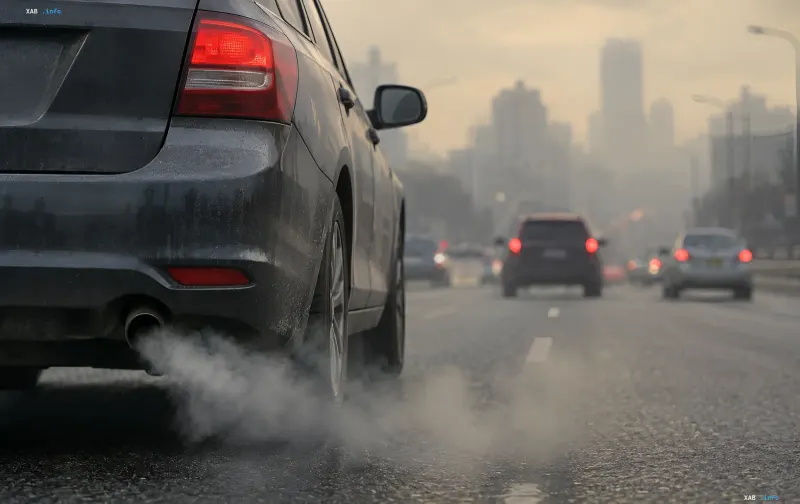
Residents of large cities rarely think about what exactly they breathe every day. Meanwhile, as specialists from the Zaporizhzhia Regional Center for Hydrometeorology have reminded, the atmospheric air of a modern industrial city is a complex and dynamic system whose composition constantly transforms under the influence of anthropogenic activity, whether intentional emissions or accidental impurities. The presence of foreign chemical compounds and suspended particles (aerosols) does not just degrade environmental quality: it 'corrects' meteorological processes themselves, forming specific weather conditions that would not exist in clean air.
Urban heat island: up to 8 degrees warmer than the background
One of the most striking consequences of pollution is the 'urban heat island' effect. Aerosols, combined with greenhouse gases and high building density, trap infrared radiation that would otherwise escape from the Earth's surface. According to hydrometeorologists, as a result, the temperature in the center of an industrial city can be 3–8 °C higher than in the surrounding rural area. This is not an abstraction: the difference is tangible both for energy consumption and for residents' well-being during hot months.
Rain and thunderstorms over the city: how impurities act as condensation nuclei
Air pollution can cardinally change precipitation patterns. Dust, sulfate, and soot particles act as artificial condensation nuclei: moisture gathers around them, leading to more frequent rains, downpours, and thunderstorms directly over the city or downwind from it. Thus, the local 'dirty' atmosphere literally redistributes the amount of precipitation, concentrating it over the urbanized territory.
Smog, fog, and loss of solar insolation
Another consequence is the formation of smog. Pollutants suppress evaporation and retain moisture in the surface layer: high humidity creates dirty fog, while sunny, windless weather produces photochemical smog. Simultaneously, atmospheric transparency decreases: a high level of dustiness, according to specialists, reduces direct solar insolation by 10–20 %, changing the surface radiation balance. This affects both temperature and the rate of photosynthesis in urban greenery.
Urban breezes: local circulation due to temperature contrast
Finally, impurities transform the wind regime. Temperature contrasts between the polluted city center and the cleaner suburbs create local air circulation. So-called 'urban breezes' arise, which draw air from the surroundings into the center. This means that clean air from the outskirts is effectively 'pulled' into the polluted zone, while polluted air is redistributed across the suburbs, closing the local cycle.
Together, these mechanisms show that air pollution is not only a matter of the quality of the mixture being inhaled, but also a factor that reshapes the city's local climate. Understanding these processes, hydrometeorologists note, is important for green space planning, urban development, and risk assessment during hot and windless periods.