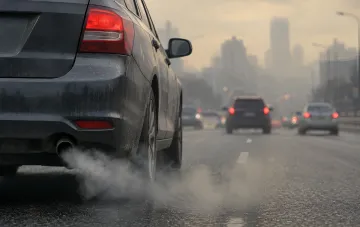
Air quality in Ukrainian cities is largely determined not only by the volume of industrial emissions, but also by the synoptic processes dominating the city at any given moment. Specialists from the Zaporizhzhia Regional Center for Hydrometeorology, whose analysis was cited by RBC-Ukraine, explained that certain atmospheric phenomena contribute to the accumulation and retention of pollutants in the surface layer, while others act as a natural mechanism for "cleaning" the atmosphere. Understanding these mechanisms is important for megalopolis residents: it dictates whether smog will linger over the city or disperse within a few hours.
Temperature Inversion — A "Lid" Over the City
One of the key factors promoting pollutant accumulation is the so-called warm air layer, which meteorologists describe as acting like a "lid." This layer blocks the vertical mixing of air masses and traps smog near the ground surface. As a result, emissions do not rise or disperse, but instead concentrate right where people breathe. It is under these conditions that persistent zones of high toxic impurity concentrations form in cities.
Stagnant Fogs and Acid Aerosols
The second hazardous factor is stagnant fogs. Water droplets making up the fog dissolve toxic gases, particularly sulfur dioxide. According to the regional hydrometeorological center, this leads to the formation of dangerous acid aerosols while trapping dust in the surface layer. Thus, fog does not just impair visibility — it transforms dry gas into a more aggressive aerosol form and "presses" pollutants down to the surface, increasing the burden on citizens' respiratory systems.
Cyclones and Weather Fronts: A Natural "Fan"
Cyclones and weather fronts have the opposite effect. They create strong upward air currents that lift pollutants into the upper layers of the atmosphere. Experts emphasize that this upward movement destroys surface zones of high toxin concentration — effectively "blowing off the lid" and allowing the atmosphere to self-clean. Therefore, a shift to cyclonic weather is usually accompanied by a noticeable improvement in urban air quality.
Wind and Precipitation: Transport and Wet Cleaning
Wind also plays a critical role. According to specialists, wind speeds exceeding 4–5 m/s are already sufficient to carry emissions beyond city limits. Meanwhile, wind direction determines which downwind areas will fall "under the blow of industrial zone plumes." Finally, atmospheric precipitation performs the function of natural wet cleaning of the atmosphere: rain and snow wash particles and gases out of the air. All these listed processes — inversion, fogs, cyclones, wind, and precipitation — work in a complex and largely explain why on some days city air is noticeably cleaner, while on others it is thick and heavy.
As meteorologists note, these patterns are especially pronounced in the urban environment, where the density of emission sources is maximal. Previously, the publication also reported on how air pollution changes the microclimate of Ukrainian cities, and explained whether dust storms threaten Ukraine and how trenches harm forests.