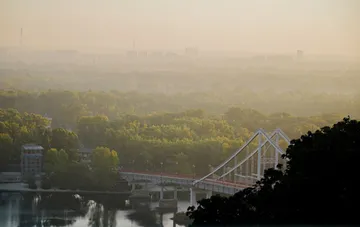
The Kyiv Regional Military Administration has recorded a moderate level of particulate matter in five settlements across the region. This is reported by RBC-Ukraine, citing agency data. The settlements in question are Ivankiv, Bila Tserkva, Vyshneve, Boryspil, and Brovary. In all other districts of the region, no excess of permissible limits for chemical and biological substances was detected, and the overall Air Quality Index (AQI) remains within normal ranges.
Where air quality has specifically worsened
According to the regional military administration, an increased concentration of particulate matter has been recorded in Ivankiv, Bila Tserkva, Vyshneve, Boryspil, and Brovary. The pollution level is assessed as moderate: it does not exceed critical values, but requires attention from residents. In all other settlements of the Kyiv region, specialists have not detected any excess of permissible levels of chemical and biological substances, and the cumulative Air Quality Index (AQI) remains within normal limits.
Recommendations for residents and vulnerable groups
The administration advises local residents to limit prolonged outdoor exposure and keep windows closed. Specialists remind that prolonged exposure to particulate matter can cause respiratory discomfort. First and foremost, this applies to children, elderly individuals, and those with increased sensitivity to irritants. It is precisely these groups that are advised to pay special attention to the time spent outdoors and, whenever possible, stay indoors with closed windows.
Radiation background and general monitoring
In addition to dust, the Kyiv region continues to monitor the radiation situation. At present, the level of gamma radiation corresponds to the natural background and poses no threat. Department specialists state that monitoring of atmospheric air condition is carried out on an ongoing basis, which allows for a prompt response to potential changes in air quality in individual areas.
The role of weather conditions in dispersing pollutants
Meteorological factors also influence the dynamics of pollutant concentrations in the air. According to the report, overcast weather and a moderate northwest wind facilitate the mixing of air masses and the dispersion of harmful substances. This means that if this wind pattern persists, local dust accumulations may gradually decrease, but until indicators stabilize in the five specified settlements, recommendations to limit outdoor time remain in effect.
Context: the impact of military actions on ecology
Earlier, RBC-Ukraine noted that military actions are accompanied by large-scale air pollution involving toxic substances, heavy metals, and carcinogenic dust. According to the publication, fires, as well as the destruction of forests and buildings, alter the local microclimate, affect wind patterns, and can trigger precipitation and dangerous weather phenomena. In the same vein, the editorial board discussed how air pollution in general affects the microclimate of Ukrainian cities. Thus, the moderate dust level recorded in five districts of the region is viewed as part of a broader picture of environmental burden associated with the consequences of hostilities.