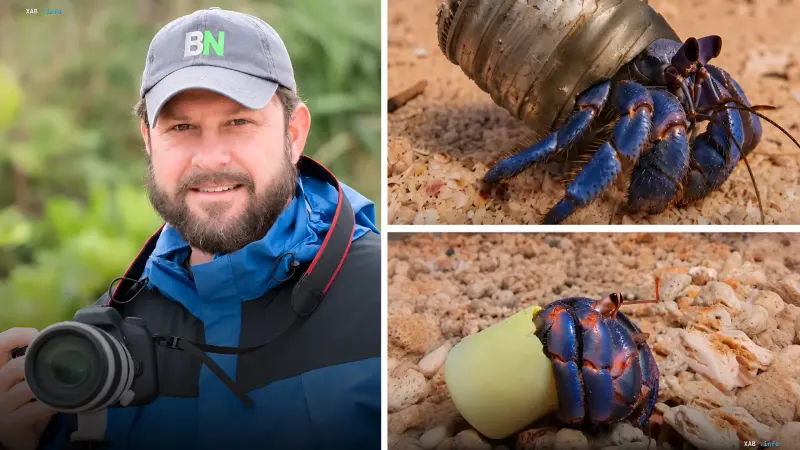
On the beaches of Okinawa, where the warm waters of the Pacific Ocean create perfect conditions for marine life, one can encounter an astonishing sight: hermit crabs whose soft abdomens are sheltered not by natural shells, but by plastic bottle caps, glass shards, and other fragments of human waste. It was this observation that became the starting point for an ecological initiative launched in 2020 by wildlife photographer Shawn Miller, who lives on the Japanese archipelago. According to him, the problem is compounded by a dual factor: on one hand, natural shells are becoming scarce on the coast, and on the other, the pollution of the coastline with waste forces crabs to use any available shelter, even those clearly not intended for marine organisms.
The 'Make The Switch 4 Nature' project: from observation to action
The name of the initiative reflects the essence of his work: literally swapping artificial, unsuitable shelters for natural shells. The project's mechanics are simple yet laborious. The photographer collects empty shells from seafood restaurants, where they are left over after meals, as well as from hermit crab breeders. Each shell undergoes cleaning and is then assigned an individual number — a special marking that allows for tracking exactly where it was returned to nature and, if possible, assessing whether a suitable individual has found it. Miller places the prepared shells in the crabs' natural habitat, where they can discover them on their own.
How crabs find a new home
The key mechanism supporting the entire project is linked to the biology of hermit crabs themselves. According to Miller, these creatures are capable of finding suitable shells by smell. This means that even a shell placed in sand or among coral debris will not go unnoticed: a growing crab that is becoming crowded in its current shelter detects a chemical signal and moves into more spacious accommodation. This is why marking each shell is important: it allows the photographer and his assistants to record relocation dynamics and understand how effectively the system works. Over the six years since the project's launch, thousands of shells have been returned to nature, which, by Miller's estimates, has significantly reduced the number of individuals forced to inhabit plastic and glass "houses".
The problem of collecting shells on beaches
In addition to helping crabs directly, Miller's initiative performs an important educational function. One of the main reasons for the shortage of natural shells on the Okinawa coast is the mass collection of shells by tourists and locals as souvenirs. Every shell taken from the beach, according to the photographer, could have been a potential home for a crab living in that area. Miller emphasizes that even a small, seemingly useless shell can be critically important for a specific individual whose size and growth stage perfectly match its volume. His appeal is directed at everyone walking along the shore: before putting a shell in your pocket or bag, consider that for someone, it is not a souvenir, but the only suitable shelter.
Significance of the initiative for Okinawa's ecology
Shawn Miller's work demonstrates how local observation of one species' behavior can grow into a systemic solution to an ecological problem. Okinawa, being one of Japan's most visited tourist destinations, faces constant pressure on coastal ecosystems. Plastic pollution, shoreline erosion, and the collection of biological resources for souvenir purposes create a cumulative effect that hits the most vulnerable inhabitants of the coastal zone. The 'Make The Switch 4 Nature' project does not require large financial investments or complex equipment — its basis consists of attentiveness, systematic labor, and the understanding that even one person, armed with a camera and a sense of responsibility, is capable of changing the living conditions of an entire population. For Okinawa, where hermit crabs are an integral part of the coastal landscape, such an initiative becomes a model for similar projects in other regions of the Pacific Ocean.