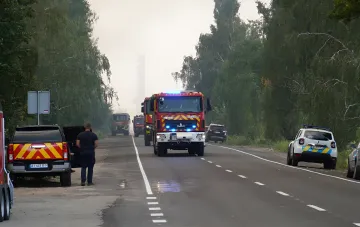
On the morning of Tuesday, September 15, 2026, a temporary deterioration in the state of atmospheric air was recorded in several settlements in the Kyiv region. This was announced by the press service of the Kyiv Regional Military (State) Administration in its official Facebook channel, as cited by the RBC-Ukraine publication. According to monitoring data, exceedances of permissible levels were not recorded at all observation points: in the other settlements of the region where regular monitoring is conducted, the concentration of chemical and biological substances in the atmospheric air remained within regulatory limits.
What exactly caused the pollution
The Kyiv Regional Administration clarified that the main pollutant of the atmospheric air in the morning hours of September 15 was fine dust — particles of the PM2.5 fraction, i.e. sized less than 2.5 microns. It is precisely this indicator that is used to calculate the air quality index using the NowCast formula developed by the US Environmental Protection Agency (US EPA). At the same time, the level of gamma radiation in the Kyiv region, according to the regional administration, corresponds to the natural background and does not pose an additional threat to public health. It is separately emphasized that no exceedances of the permissible concentration of chemical and biological substances in the atmospheric air were observed at other monitored points in the region.
Contradictory data
Meanwhile, in publications by various media outlets referencing the same primary source — the post by the Kyiv Regional Administration — there is a discrepancy in the number of affected settlements. The text published by RBC-Ukraine mentions "several cities" in the Kyiv region where a temporary deterioration was recorded. At the same time, the Interfax agency, citing the same data, states that the deterioration in air quality was recorded specifically in two settlements in the region. The specific names of the cities or towns are not disclosed in the provided editorial materials, which makes it impossible to definitively determine the exact number of locations in question. The Kyiv Regional Administration, judging by its original post, apparently provided a list of specific points, but this detail was lost or generalized in media retellings. Until an official clarification from the regional administration is issued, both versions — "several cities" and "two settlements" — remain in the public eye.
Context: connection to military actions and weather
An important addition to the morning report on air quality was a publication by UNN, which linked the deterioration of the environmental situation in the Kyiv region to the aftermath of 38 enemy attacks recorded in the region. Although the Regional Administration's message itself does not declare a direct causal link between the military incidents and the rise in PM2.5 concentration, the logical chain is obvious: explosions, fires, and infrastructure destruction generate a significant amount of fine dust, which, under conditions of weak wind activity and temperature inversion — typical for September morning hours — does not disperse and accumulates in the ground-level layer. Previously, XAB.info reported that a sharp cooling is coming to Ukraine in September 2026, and also explained how exactly the synoptic situation — calm, inversion, low cloud cover — affects air quality and hinders natural atmospheric ventilation.
How to monitor air quality on your own
For residents of the Kyiv region and other regions of Ukraine interested in timely monitoring of the environmental situation, the Ukrainian ecological system SaveEcoBot is available. The platform aggregates data on the state of air in settlements across the country in real time and calculates the air quality index using the NowCast methodology (US EPA) for the main pollutant — fine dust of the 2.5-micron fraction. Users can subscribe to notifications and receive alerts about exceedances of permissible levels in their location. In conditions where the morning hours of September 2026 in the Kyiv region showed local but real exceedances of PM2.5, regular use of such services becomes not just useful, but a practically necessary element of caring for one's own health and the health of loved ones.