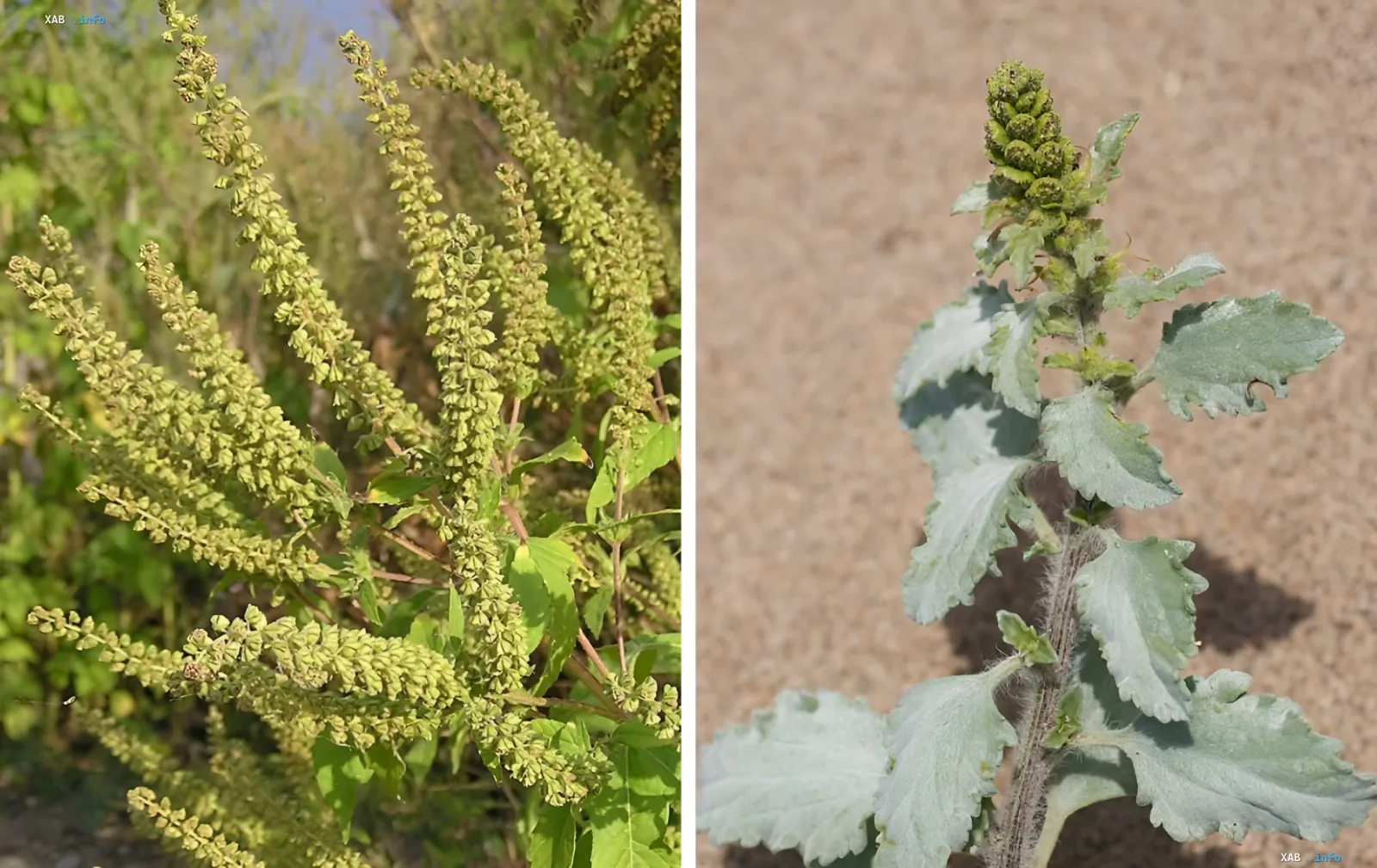
Ambrosia is often perceived as an ordinary weed until it starts rapidly taking over open spaces in the vegetable garden, along the fence, or in the orchard. The main trap is that simply mowing it once is not enough: the plant regrows, and its seeds can wait in the soil for years. That is exactly why fighting ambrosia often turns into a multi-year story if you approach it as a one-off cleanup rather than a systematic task.
What this plant is and why it is dangerous
Ambrosia is an annual weed native to North America. In Ukraine it is classified as a quarantine organism, and it thrives wherever the soil is left exposed: in vegetable gardens, orchards, along roads, on wastelands, and on plots with disturbed vegetation. In other words, where a gardener regularly tills the soil and leaves it bare, ambrosia gets ideal conditions for establishing itself.
How ambrosia comes back every year
The key reason the weed does not disappear is its seed reproduction. A single well-developed plant can produce tens of thousands of seeds, and some individuals — up to 100,000. Moreover, the seeds remain viable in the soil for up to 40 years: if ambrosia grew on the plot a few years ago, that does not mean the soil has forgotten about it. Add to this a staggered germination pattern — young plants can appear throughout the entire season, so after the first weeding it seems the problem is solved, but a few weeks later the characteristic shoots emerge from the ground again. By the way, the seeds do not necessarily arrive on their own: they are carried by water, vehicles, footwear, animals, hay, straw, soil, seedlings, and various materials, and in winter the wind scatters seeds from uncut plants. Hence the simple answer to the question “where did it come from if it wasn’t here last year” — the seeds may have arrived together with soil, seedlings, or stuck to your shoes.
Harm to the garden and to people
For the garden itself, ambrosia is far from harmless. It quickly builds up green mass, has a powerful root system, and competes with cultivated plants for water, nutrients, and space. In addition, the plant releases substances that can inhibit the germination and growth of other plants. And as an extra downside: ambrosia is extremely toxic and a very strong allergen, so allowing it to bloom en masse near dwellings is not advisable.
How to fight it: the main rule
The main rule is to prevent ambrosia from forming seeds. This should be the primary goal of the fight, not just a pretty, clean garden after a single weeding. If there is little of the weed, the easiest thing is to pull it out by the root while the plant is still young and the root has not become powerful. Uprooted plants should not be left lying on the bed, especially if they already have flower heads: immature seeds can continue to ripen after being cut. On large areas, mowing should be regular, not one-off — the State Service of Ukraine on Food and Safety recommends repeating mowing roughly every 2–3 weeks, not allowing the plant to reach flowering and seed formation. It is better to go over the area with a mower several times a season than to mow tall ambrosia once at the end of summer. It is also important not to leave the soil bare after clearing the plot: on open spaces, a dense sward or other plants that quickly cover the soil and create competition for the weed helps, especially between trees, near fences, and in strips of untreated ground. And do not meticulously tend your beds while leaving overgrowth beyond the fence — that way the plot constantly receives a fresh supply of seeds. After each cleanup, the soil should be periodically inspected, especially after rain, since seedlings do not appear all at once.
Contradictory data
Here the sources disagree. The basis of the article (Styler material) presents regular mowing on large areas at 2–3 week intervals as a working method that prevents ambrosia from flowering and setting seed. At the same time, the publication glavred.info states outright in its headline that mowing with a trimmer “only does harm.” Both sides agree on one point: a single mowing of tall ambrosia at the end of summer is useless and even harmful. The disagreement comes down to the tool and the logic: one view bets on frequent repeat mowings as a way to suppress flowering, while the other warns that trimmer mowing in particular can be counterproductive (for example, due to cutting at a harmful height and not removing the root). The reader should take both positions into account: frequency and control of flowering matter, but the choice of tool and the depth of treatment require caution and testing on your own plot.
The younger the ambrosia, the easier it is to remove. And the gardener’s real victory is not when they pull out a tall plant, but when they prevent it from leaving behind thousands of new seeds.