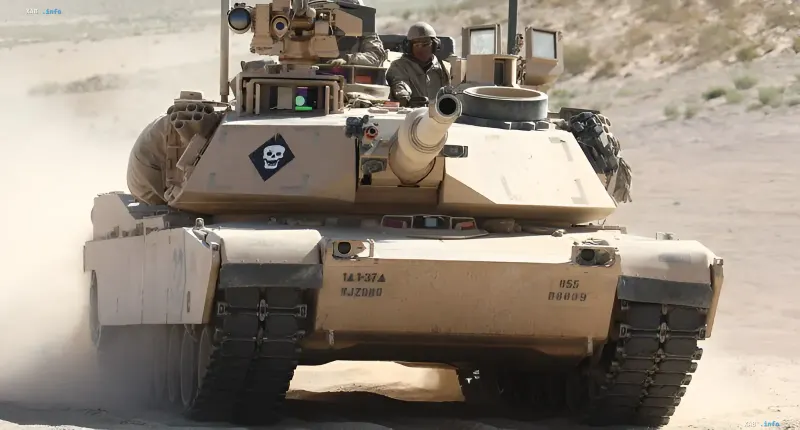
The American M1A2 Abrams main battle tank and Stryker armored vehicle will soon be equipped with the innovative PERCH 2.0 system. This development opens up new capabilities for the US ground forces, allowing crews to effectively counter modern battlefield threats by integrating loitering munitions directly onto armored vehicles.
Innovative PERCH 2.0 Concept
The acronym PERCH 2.0 stands for Precision Effects & Reconnaissance, Canister-Housed. This canister-launched system is mounted onto vehicles without requiring any significant or destructive modifications to their standard chassis. Developed through a joint effort by General Dynamics Land Systems (GDLS) and AeroVironment, this system combines advanced expertise in armored vehicles and unmanned aerial systems.
Advantages and New Combat Capabilities
The main advantage of the system is the ability for the crew to launch Switchblade cruise missiles and drones from directly beneath the armor, entirely eliminating the need to leave a protected space and expose themselves to danger. For reconnaissance and monitoring tasks, PERCH 2.0 is equipped with electro-optical and infrared sensors mounted on rotating gimbals, providing real-time video feeds for high situational awareness. This new technology enables vehicles to engage targets at significant distances, far beyond direct line-of-sight and the standard firing range of their conventional 120mm main gun.Testing and Delivery Plans
The upgraded reloading mechanism of the system was designed based on data from 2025 tests at Fort Hood, Texas. According to current reports, GDLS plans to deliver four PERCH 2.0 prototypes to the 1st Brigade of the 1st Cavalry Division of the US Army at Fort Hood by the end of October 2026. Soldiers will install these systems on Abrams tanks for field testing under real operational conditions.Contradictory Data
During the analysis of open sources and specialized industry reports, certain discrepancies have been noted regarding the exact volumes and timeline of government contracts. Some sources indicate that the initiative was entirely funded through GDLS internal research and development budgets based on US Army feedback, while other reports confirm an official US Army contract for three additional prototypes in August under the Abrams technical support framework.