For our ancestors, going to the forest for mushrooms was never just a way to gather food. Dozens of strict rules, taboos, and omens were associated with it — from predicting future harvests based on morning fog or insect behavior to mysterious legends about fairy rings, which European traditions linked with supernatural beings.
The Mystery of Fairy Rings and Scientific Explanation
When mushrooms grow in a nearly perfect geometric circle, it still looks somewhat mystical today. In various European cultures, such formations were called witch rings and people were strictly warned against stepping inside them to avoid misfortune.
However, modern science explains this phenomenon much more prosaically. The mycelium grows underground radially from the center outward, and the fruiting bodies appear along the edge of its growth zone, gradually forming the characteristic ring.
Volyn Polissya Traditions and Forest Silence
Ethnographic materials from Volyn Polissya preserve many unusual rules of quiet hunting. For instance, there was a belief about the first mushroom found in the season: a tiny mushroom could be intentionally left in the forest, believing it would grow no more, while in other regions, the opposite tradition advised taking it home.
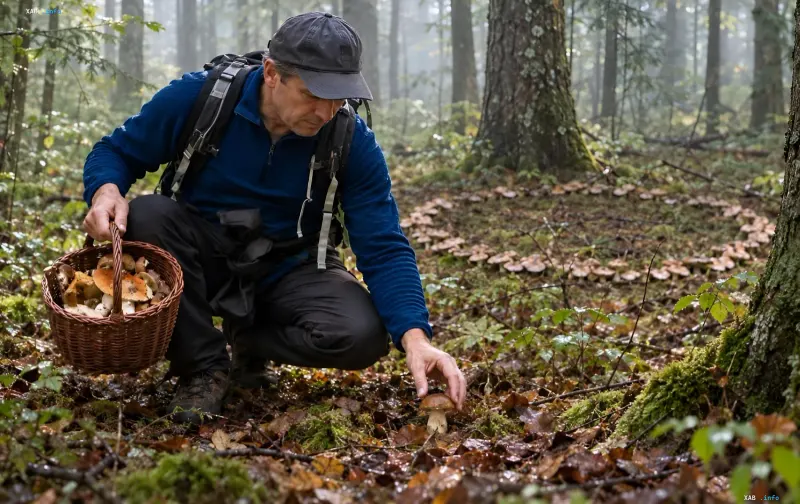
Another curious belief concerned the behavior of the mushroom hunter. It was believed that one should not speak loudly, shout, or boast about harvested mushrooms, otherwise they might hide. Today, this has a practical explanation: a quiet and attentive person has a much better chance of spotting a mushroom under the leaves.
Contradictory Data
Folk beliefs often contained direct contradictions depending on the locality. This was evident in lunar calendars: some believed mushrooms grew best during a new moon, while others were convinced that a waning moon was required. Such discrepancies are well-documented in ethnographic studies.
Harvest Omens and War Predictions
Forebears predicted mushroom years by natural indicators: morning fog signaled a fruitful year, while blooming wild roses and strawberries indicated the appearance of the first russulas. Among the gloomiest beliefs was the omen "many mushrooms mean war," which should be viewed strictly as folklore rather than a real prediction tool.