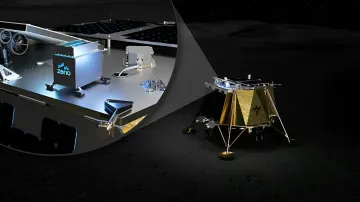
The onboard computer that enabled the first human landing on the Moon in 1969 is today outperformed in computing terms even by simple household devices — from graphing calculators to smart LED bulbs. The AGC (Astronautical Guidance Computer) module that controlled the Apollo 11 spacecraft was designed under the strictest mass constraints: it had just 4 KB of RAM and 72 KB of ROM, with a processor clock speed of around 0.043 MHz. By comparison, virtually any modern consumer device exceeds these figures by hundreds of thousands or even millions of times, vividly illustrating the scale of the technological leap over the past half-century.
The “heart” of the lunar mission: what the AGC was and why it was so modest
Engineers of the 1960s Moon program were forced to strike a compromise between computing power and equipment mass, since every kilogram on board required enormous effort to launch. As a result, the AGC was extremely frugal: 4 KB of RAM and 72 KB of ROM at a clock speed of about 0.043 MHz and a mass of roughly 30 kg. These specifications, which seemed cutting-edge for their time, today look more modest than many everyday gadgets that users keep in their pockets or plug into an outlet with no cosmic context whatsoever.
Calculator and smart bulb: consumer electronics outpace space
A graphing calculator, such as the TI-84 model, runs roughly 350 times faster than the AGC, with 149 KB of RAM and 3 MB of ROM — surpassing the lunar module in both speed and memory capacity. The smart LED bulb is equally telling: its processor runs at a clock speed of 192 MHz and is equipped with 276 KB of RAM and 128 KB of ROM, enough to manage wireless connectivity and operating schedules. Thus, even devices perceived as “everyday trifles” possess resources that the engineers of the Moon program could only have dreamed of.
Car and smartphone: a gap of millions of times
The gap becomes even more obvious with automotive and mobile electronics. Standard Android-based multimedia systems require at least 4–8 GB of RAM, a million times more than the memory of Apollo 11, while premium media platforms can use up to 24 GB of RAM. Modern smartphones are no exception: the iPhone is equipped with 8 to 12 GB of RAM, two to three million times the parameters of the lunar module. Notably, during the Artemis II orbital mission, astronauts used the iPhone 17 Pro Max as cameras for filming, symbolically underscoring the role reversal between “space” and “consumer” equipment.
Smartwatches and the question: why everything was computed on board
Smartwatches are a vivid example of technological progress: a gadget weighing just 61.5 grams, such as the Galaxy Watch Ultra 2, has 2 GB of RAM, half a million times more memory than the AGC, which weighed about 30 kg. At the same time, it is important to understand why such modest computing power had to suffice in 1969. NASA's ground computers at Mission Control had significantly greater computing capabilities, but due to a radio signal delay of several seconds, all critical navigation calculations had to be performed right on board the spacecraft, without waiting for a response from Earth.
The technological leap: conclusions
The totality of these comparisons shows how rapidly computing technology has developed since the 1960s: devices that are considered commonplace today possess resources many times greater than the onboard computer that enabled the first human step onto the Moon. This does not diminish the achievement of Apollo 11; on the contrary, it underscores how complex a task the engineers of that era solved with minimal computing means — and how far electronics have come since then.