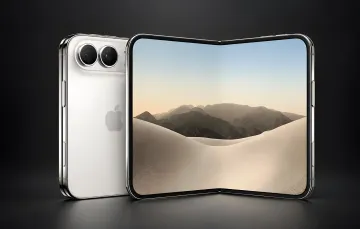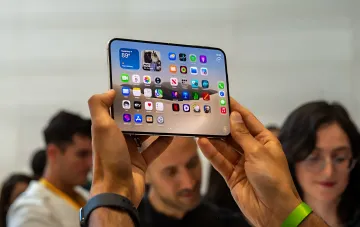
Official shipments of Apple's first foldable smartphone, the iPhone Duo, are set to start on Friday, October 23, 2026. However, according to RBC-Ukraine citing tech reviewer Ice Universe on X, some users received the device a few days early and have already noticed issues with the display coating in the folding area. Early access to the device has revealed nuances that were not visible during presentations, and these are now raising the most questions among early owners.
A Different Philosophy: Soft Coating Instead of UTG
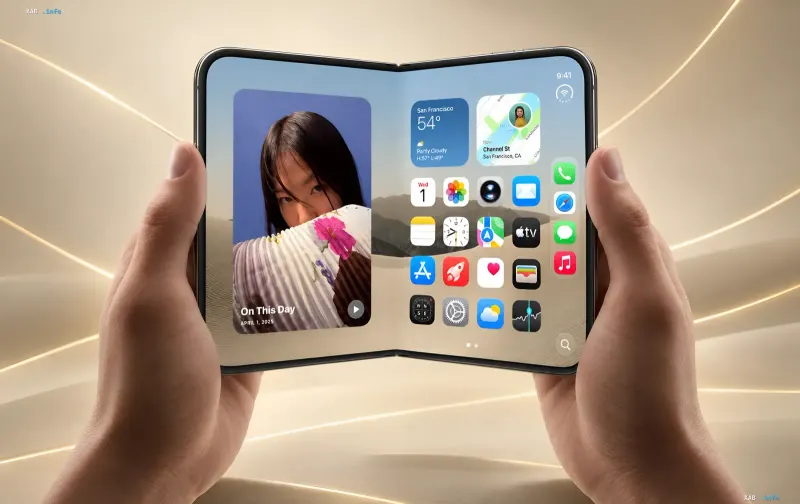
During initial reviews at the launch event, analysts and bloggers praised Apple for a virtually invisible crease on the iPhone Duo screen. Real-world usage experience, however, has shown the flip side of this decision. Cupertino implemented an approach that differs from competitors' strategy: while Samsung uses Ultra Thin Glass (UTG) in its Fold series to create a rigid surface, Apple opted for a softer protective coating. According to the developers' intentions, this should allow for relatively inexpensive layer replacement in case of scratches, but this very "softness" has become the source of initial complaints.
What Early Users Are Reporting
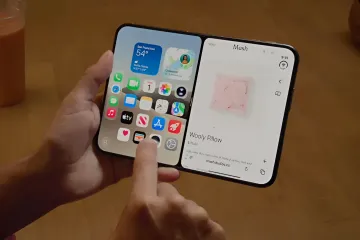
Early video reviews by real users demonstrate that the coating over the hinge turned out to be too soft. A Weibo user under the handle Kang, who gained hands-on access to the device, reported that the screen crease feels unexpectedly soft to the touch: pressing in this area with a fingernail or finger edge can leave noticeable creases. According to him, this behavior is reproducible across multiple devices, ruling out a one-off defect. This raises questions about how the design relates to the variable-thickness UTG mentioned in leaks — with a thinner central folding area and thicker surrounding zones: Apple may have chosen a fundamentally different way to manage stress around the fold.
Visually Almost Invisible, Tactilely Different
An important nuance pointed out by early reviews is the gap between visual and tactile perception. When the screen is simply on and untouched, the crease is barely noticeable. However, when sliding a finger across the center line of the display, it becomes not only clearly visible but also physically palpable, as the hinge zone bends under pressure. It is this combination of "invisibility at rest" and "softness upon contact" that sets the iPhone Duo apart from competitor solutions, where the surface in the crease area usually feels much harder.
Durability in Question
It remains unknown how this design will behave over time. On many foldable smartphones, the crease becomes more prominent as the number of folding and unfolding cycles increases, and a soft coating theoretically might wear out faster than rigid glass. More constructive and comprehensive conclusions about screen reliability can only be made after the mass market release of the device and the accumulation of statistics from a large number of users. Currently, the recorded observations apply to a limited number of early samples and should be viewed as preliminary.