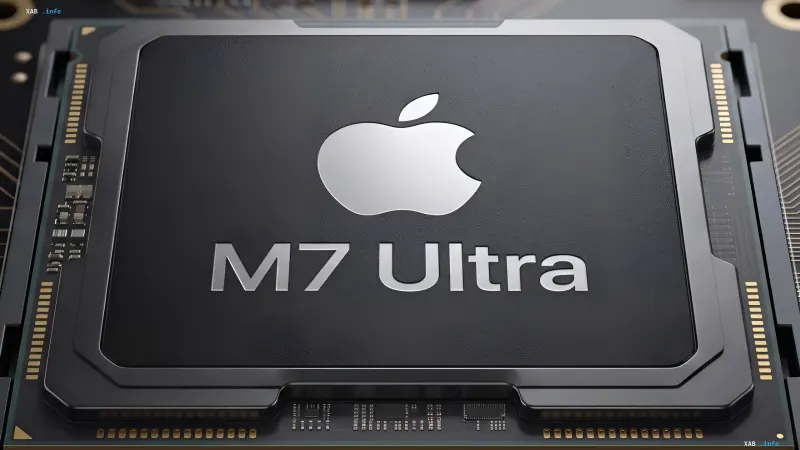
The world of technological innovation is once again on the brink of major changes. Renowned insider Mark Gurman has revealed exclusive details about Apple's long-term strategy for its own Apple Silicon processors. It turns out that the Cupertino company is radically revising its development approaches, deciding to significantly accelerate the pace of creating new chips.
Accelerating the development cycle
The traditional cycle of Apple processor creation, which has always been characterized by thoroughness and length, is undergoing changes. According to the data obtained, the design of the next-generation chips, the M7 family, began just six months after the completion of the corresponding stage for the M6. Such a compression of deadlines indicates that Apple intends to respond faster to growing market demands and outpace competitors in the race for computing power.
Revolution in memory capacity
One of the most impressive aspects of the upcoming M7 Ultra flagship is its memory architecture. Apple plans to support up to 1.5 terabytes of unified memory. For comparison: this is twice as much as was originally planned for the M5 Ultra model, and three times the maximum limit of the currently relevant M3 Ultra, which stands at 512 GB.
Such a leap in memory capacity opens up limitless possibilities for working with heavy data, neural networks, and complex computational tasks that were previously unavailable for desktop and portable systems.
The battle for artificial intelligence
Apple's management has set an ambitious goal: to bring the performance of its flagship chips in artificial intelligence tasks closer to the level of specialized server solutions. The NVIDIA Blackwell architecture is named as the benchmark. This means that Apple intends not just to catch up, but to challenge the leaders of the server market by offering competitive AI solutions directly in consumer devices.