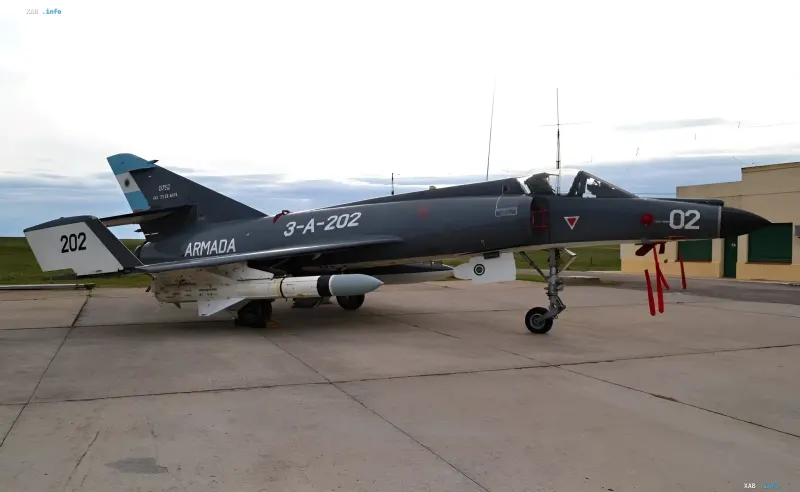
Roman Enrique Olivero, Commander of the Argentine Navy, announced the retirement of the Super Étendard carrier-based attack aircraft. The decision marks the end of a long-running effort to return to service the aircraft that made their name in the 1982 Falklands War but which, over decades of service, had become a technically burdensome asset. According to the commander, the main reason was not airframe wear, but dependence on British ejection systems that cannot be maintained under export restrictions.
Reason for Retirement — Martin-Baker Ejection Seats
The key problem that led to the retirement of the attack aircraft turned out to be the Martin-Baker ejection seats of British manufacture. Their operation requires special types of ammunition (pyrotechnic charges) that Argentina cannot obtain due to UK export restrictions. Without access to these components, the ejection system is effectively unmaintainable, making flight impossible from the standpoint of crew safety.
Modernization Attempt with France
In 2019, Argentina received five modernized Super Étendard Modernisés (SEM) under an agreement with France worth 14 million euros. The package included spare parts and a simulator. However, according to the publication, the Argentine military was unable to restore the flying capability of these fighter-bombers, and the aircraft never returned to full operational service.
Shifting Decisions: From Removal from the Register to an Attempted Restoration
In 2023, then-Argentine Defense Minister Jorge Taiana decided to remove the Super Étendard from the naval aviation register. A year later, this decision was reversed, and talk of possibly restoring the aircraft resumed. In August 2024, Navy Commander Admiral Carlos María Alíev announced plans to conduct test flights after restoring the ejection system; the work was to be carried out by MBA Argentina, a company affiliated with ejection-seat manufacturer Martin-Baker. Nevertheless, the Directorate of Military Aviation (DIGAMC) never authorized the test flights, and the Navy abandoned further attempts to return the Super Étendard to service.
Connection to Ukraine and the Falklands Legacy
Meanwhile, in June 2024, the Argentine government was considering transferring Super Étendard carrier-based attack aircraft to Ukraine, capable of carrying anti-ship missiles. The historical significance of the type is confirmed by the 1982 Falklands War: on 4 May, two aircraft from Río Grande air base, refueled by a KC-130H Hercules, attacked the British destroyer HMS Sheffield with two AM39 Exocet missiles — one missed, the second hit and caused a fire, leading to the ship being abandoned and sinking. On 25 May, a pair of Super Étendard, aiming for the carriers HMS Hermes or HMS Invincible, accidentally struck the anchored container ship Atlantic Conveyor with both missiles, which also sank. During the war, Argentine Super Étendard carried out five combat sorties in pairs.
Contradictory Data
The source materials contain an inconsistency in the classification of the aircraft: in one place it is stated that the type in question is the same one Argentina received from France in 2019 and which "played a decisive role" in the Falklands War, while in another — that the aircraft mentioned "do not belong" to the type received in 2019. In fact, the 2019 SEM are a modernized version of the same family that took part in the 1982 conflict, so the source's wording contradicts itself. Moreover, the chronology of decisions (removal in 2023, reversal "a year later", Alíev's plans in August 2024, and the parallel consideration of a transfer to Ukraine in June 2024) is presented in a fragmented manner, and the exact sequence of administrative steps is not unambiguously clarified in the original source.