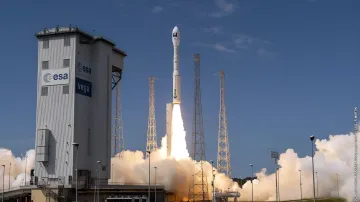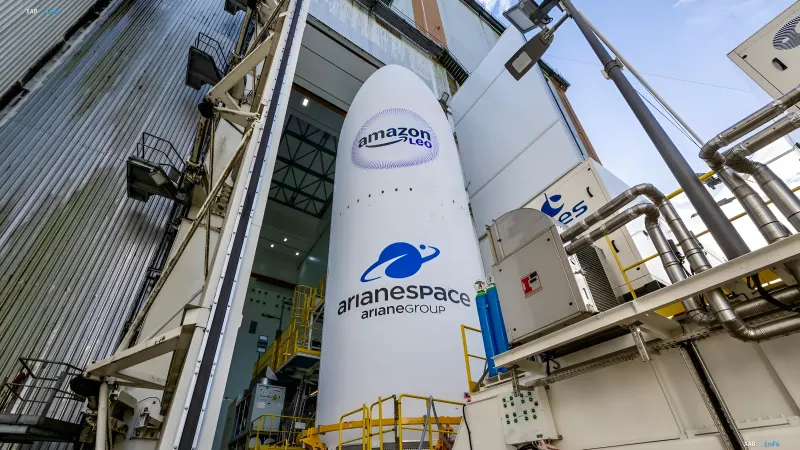
The European Ariane 6 carrier rocket is preparing for the tenth flight in its history. As part of the Leo Europe 4 (LE-04) mission, 36 satellites for the Amazon Leo internet system will be delivered to low Earth orbit. The launch is scheduled for November 23, 2026, from the launch complex at the Guiana Space Centre in French Guiana. The launch window will open at 11:09 UTC and remain open until 11:38 UTC. According to operator Arianespace, the batch of 36 spacecraft has already been prepared for integration with the carrier rocket prior to launch.
Maximum Ariane 64 Configuration
To deploy 36 satellites, the most powerful version of the rocket—Ariane 64—will be used, equipped with four P160C solid-fuel boosters. This specific configuration allows for lifting approximately 21.6 metric tons of payload into low Earth orbit, which is more than double the capacity of the two-booster version used in the first five flights. The strap-on boosters consume about 142,000 kilograms of solid propellant in just two minutes of operation before burning out. For Arianespace, this launch will be the fourth on behalf of Amazon Leo, and the tenth overall in the Ariane 6 flight series.
Amazon Leo: Expanding the Constellation Against Starlink
The LE-04 mission satellites will augment the Amazon Leo constellation—a satellite internet project designed to provide broadband connectivity, including in regions where traditional communications are unavailable or poorly developed. The company is steadily deploying its constellation in low Earth orbit, competing with other satellite access systems, most notably Starlink. As of early 2026, Amazon Leo has already placed more than 170 spacecraft into orbit and intends to expand the constellation to 3,200 satellites, whereas its main competitor has nearly 9,400 spacecraft in orbit.
The Shadow of the Vulcan Centaur Failure
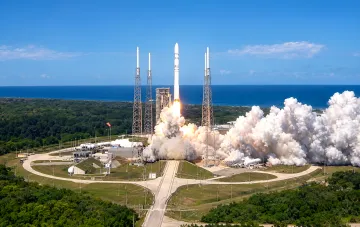
The scheduling of the European launch for November 23 comes against the backdrop of a recent incident involving an American carrier. Last week, ULA's Vulcan Centaur rocket was set to launch 40 Amazon Leo satellites, but the mission ended in failure. According to ULA, an issue arose in the first stage of the Vulcan Centaur almost immediately after liftoff, with telemetry loss recorded approximately 10 minutes into the flight. Consequently, the deployment of the next batch of Amazon Leo spacecraft has shifted to Europe's Ariane 6, increasing the significance of the LE-04 mission for the constellation's deployment schedule.
A Symbol of European Sovereignty
The Ariane 6 program is supported by 13 countries—all members of the European Space Agency—with around 600 companies contributing to the rocket's creation. Although Ariane 6 is promoted as a symbol of European sovereignty in the aerospace sector, its key commercial partner is the American company Amazon. A successful tenth launch in the maximum configuration will demonstrate Europe's capability to independently and in large volumes deploy satellite constellations, reducing its dependence on American and other launch vehicles.