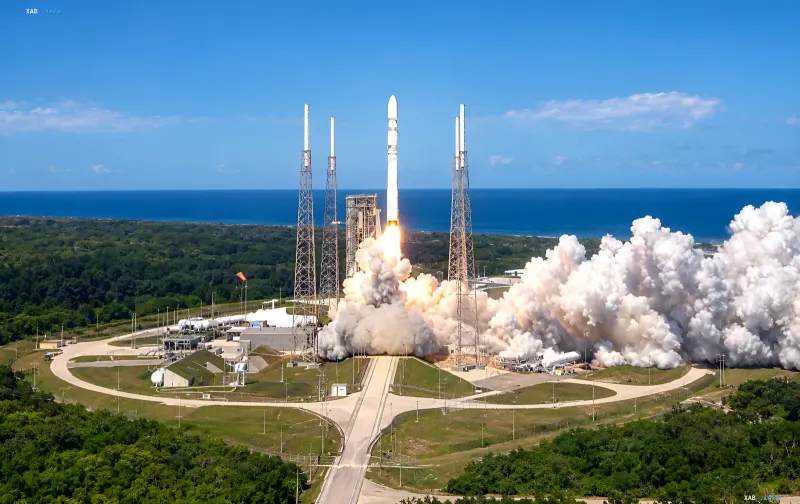
On November 15, 2026, at 7:40 PM Kyiv time, a Vulcan Centaur rocket, developed by the United Launch Alliance (ULA) joint venture — Boeing and Lockheed Martin — launched from Space Launch Complex 41 at Cape Canaveral Space Force Station (Florida). On board were 40 satellites for Amazon's broadband Leo network, which Amazon is deploying as a direct competitor to SpaceX's Starlink. The mission's objective — to place the entire payload into low Earth orbit — was not met: an anomaly occurred at approximately the tenth minute of flight, after which the vehicle failed to deliver the satellites to the intended orbit.
Launch Progress and Moment of Failure
According to the launch director, the failure was recorded approximately 10 minutes after liftoff. About 50 minutes into the mission, ULA officially confirmed the loss of the payload, noting that the exact causes of the incident were still being determined at the time of the statement. The company cited the launch director, stating that the rocket "experienced a failure at the ten-minute mark of flight and was unable to place the Amazon payload into orbit." The solid rocket boosters, which had caused issues in previous launches, performed nominally this time; the malfunction occurred at a later stage of flight.
First Total Payload Loss in Two Decades
This incident marks the first total payload loss for ULA since the company's founding in 2006. For Vulcan Centaur, the successor to the Atlas V rocket that debuted in January 2024, this was its fifth flight and the first in nine months. The gap between launches was extended due to two separate technical investigations — one concerning the solid rocket boosters and another regarding the first-stage BE-4 engines. The latest launch was viewed as a "return to flight" mission for the rocket, which was intended to establish regular launches for deploying the Amazon Leo network.
History of Vulcan Issues: From Booster Nozzles to the BE-4 Engine
Of the four previous flights, two were accompanied by technical malfunctions. During the second launch in October 2024 and the fourth in February 2026, a nozzle on one of the solid rocket boosters burned and detached approximately 30 seconds after liftoff. In both cases, the rocket was able to compensate for the damage and place the satellites into orbit, but the U.S. Space Force suspended national security launches on Vulcan until the defect was resolved. ULA spent about nine months refining the nozzle design and changing manufacturing processes, which allowed the boosters to perform as expected during the November 15 launch.
What This Means for Amazon Leo and Competition with Starlink
Mission Vulcan Leo 1 was the first launch of Amazon satellites on a Vulcan rocket. The Amazon Leo network, formerly known as Project Kuiper, is expected to eventually count over 3,200 satellites and is positioned as a direct competitor to Starlink. Prior to this accident, the company had already placed about 400 satellites into orbit through 15 successful launches of Atlas V, Falcon 9, and Ariane 6 rockets. The loss of 40 satellites in a single launch is a significant blow to the deployment pace of the constellation and the reputation of the carrier, which the company relied on for regular launches.
What Next: Investigation and the Future of Vulcan
The further deployment of Amazon's satellite constellation on ULA rockets will depend on the results of the accident investigation. The company emphasized that every flight provides new data and expressed hope to learn lessons from this launch. While the exact cause of the failure at the ten-minute mark is not yet determined, the question of resuming Vulcan launches and the timeline for restoring the schedule for the Leo network remains open.