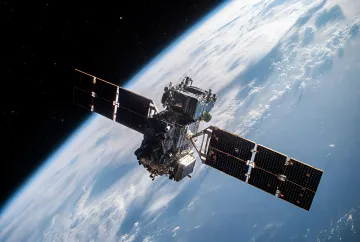
The US Federal Communications Commission (FCC) has approved the estimated $11.5 billion acquisition of satellite operator Globalstar by Amazon Leo, Amazon's satellite division building its own low-Earth orbit communications network. The regulator's decision removes the primary legal hurdle for one of the most ambitious projects in commercial space history: Amazon acquires not only Globalstar's assets, but also critical frequencies enabling direct satellite connectivity to subscriber smartphones without special equipment.
Regulatory Approval and Deal Scale
According to the FCC, Amazon has committed to investing more than $10 billion in the Leo project and intends to begin commercial service by the end of 2026. The regulator emphasized that Globalstar's assets will allow Amazon Leo to enter the direct-to-device satellite connectivity market and provide both fixed and mobile communication services. Thus, the approval concerns not simply the purchase of a company, but the transfer of a radio frequency spectrum package formerly owned by Globalstar, which will now form the backbone of Amazon's consumer network segment.
Amazon Leo Constellation Deployment Plans
Since April 2025, Amazon Leo has already launched approximately 400 satellites, and the company intends to deploy several thousand more spacecraft in low-Earth orbit by 2029. In July of this year, Amazon filed an application to deploy a constellation of up to 5,105 satellites. This is one of the largest orbital projects ever proposed by a private operator, aiming to build infrastructure capable of competing with the market-dominating Starlink network, whose constellation exceeds 11,000 spacecraft.
Strategic Value of Globalstar Assets
Under the deal, Amazon acquires about two dozen Globalstar satellites and frequencies for smartphone satellite communications. This exact element makes the acquisition strategically vital: without access to the corresponding spectrum, direct connection of ordinary phones to low-orbit satellites would be impossible. Through Globalstar's assets, Amazon Leo will be able to provide fixed and mobile services directly to user devices, putting it on par with operators already active in this segment.
Role of Apple and Its Equity Stake
Globalstar powers emergency communication and location-finding features on iPhones and Apple Watch devices. Amazon has reached an agreement with Apple ensuring these services will continue to be provided. In 2024, Apple invested about $1.5 billion in Globalstar and acquired a 20% equity stake in the operator as part of the arrangement. Last year, Apple accounted for approximately 63% of Globalstar's revenue. As part of the takeover deal, Amazon plans to acquire Apple's stake as well, effectively making it the sole owner of the operator upon completion of the process.
Competitive Landscape and Outlook
Starlink remains the leader in the satellite communications market with over 11,000 spacecraft in its constellation. The new network being developed with Apple's support will help Globalstar increase its satellite count to 54, including spares—currently, the operator uses only about two dozen. For Amazon, this means not simply buying a competitor, but acquiring a ready-made technological and frequency foundation that accelerates entry into the consumer market. The combined effect of the deal—$11.5 billion in investments and a commitment to invest over $10 billion more in Leo's development—makes Amazon one of the few players capable of challenging Starlink's monopoly on global satellite communications in the medium term.