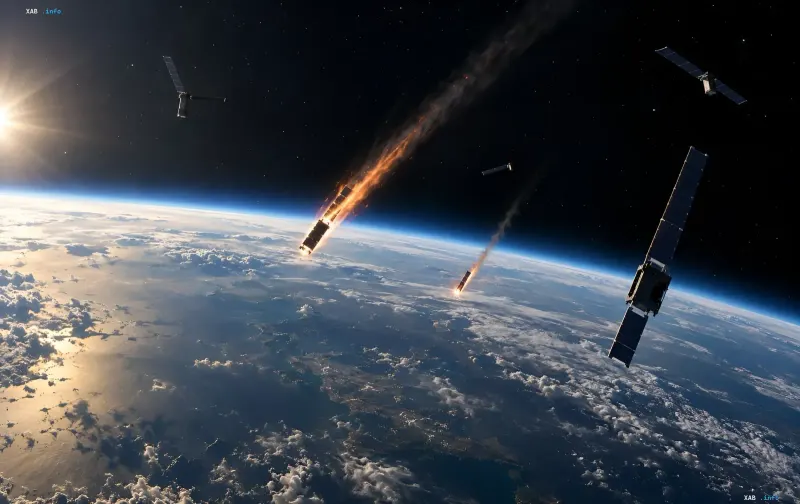
Since 2019, SpaceX has launched more than 10,000 Starlink satellites into low Earth orbit, making it the largest telecommunications constellation in human history. However, each of these satellites has a limited lifespan and inevitably leaves orbit over time. According to the Orbital Radar space monitoring system, 445 cases of Starlink satellites entering Earth's atmosphere were recorded between January 1 and October 22, 2026. This means an average of one to two spacecraft deorbit every day—a process that will only accelerate in the coming years.
Why Satellites Fall and How It Happens
Most Starlink spacecraft are deorbited by the operator after completing their five-year operational lifespan. Some satellites leave orbit prematurely due to technical malfunctions or loss of power. Low Earth orbit, where the most massive V2 Mini models operate (at altitudes between 450 and 490 km), is subject to constant atmospheric drag. It is this effect that naturally disposes of malfunctioning units, preventing them from turning into long-term space debris. Upon high-speed entry into the dense layers of the atmosphere, the temperature around the body rises to critical values: the structure breaks apart, and the vast majority of materials completely vaporize. Starlink satellites are designed to burn up entirely, but as practice shows, this scenario is not absolute.
A Canadian Farmer and a 2.5-Kilogram Part: The Incident That Changed Calculations
In 2024, Canadian farmer Dan Kennedy discovered a 2.5 kg aluminum component the size of a laptop in his field. SpaceX specialists confirmed it was part of a Starlink satellite antenna cover. Investigation showed the spacecraft had entered too low an orbit due to a deployment error by the Falcon 9 rocket. Solar panels, which were supposed to induce chaotic tumbling of the body upon atmospheric entry, held the satellite in a stable orientation. As a result, structural breakup occurred at a lower altitude than calculations predicted, and the part failed to vaporize. Following an analysis of the incident, SpaceX adjusted its thermal heating models and updated the design of the next generation—V2 Mini Optimized.
The Scale of the Future: Tens of Thousands of Spacecraft and a 20 Percent Fleet Replacement
In the coming years, the number of atmospheric satellite reentries will multiply. In addition to SpaceX, Amazon (Project Leo) and Chinese operators (Spacesail and Honghu-3 projects) are deploying their own massive constellations. Combined, this will add tens of thousands of new spacecraft to low Earth orbit. Given that about 20 percent of the entire satellite fleet needs replacement every five years, thousands of spacecraft will enter the atmosphere annually. Against this backdrop, low Earth orbit is already turning into a zone of increased density: according to reports from 2026, the Starlink constellation performs more than 200,000 collision avoidance maneuvers every six months, and an average satellite "dodges" neighboring spacecraft and debris more than 40 times a year.
Chemical Atmospheric Pollution: A Threat That Is Hard to See
In addition to the risk of unburned debris falling onto populated areas, scientists are sounding the alarm over chemical pollution in the upper atmosphere. When satellites burn up, aluminum oxide is released into the stratosphere and mesosphere—a compound that can persist in the atmosphere for decades and gradually deplete Earth's ozone layer. While emission volumes are currently small, with the projected exponential growth in atmospheric entries, the problem could transcend local incidents and become a systemic environmental factor requiring international regulation.