Atomic-6 has completed a series of laboratory tests on its new Space Armor composite shield, designed to protect orbital spacecraft and personnel from hypervelocity collisions with space debris. According to RBC-Ukraine, citing Interesting Engineering, the initial tests were successful: the composite tile absorbed an impact that would have penetrated conventional metal protection. The experiments were conducted at the Texas A&M University Hypervelocity Impact Laboratory, making it possible to replicate the conditions of a real orbital debris collision.
Why Space More Dangerous Than It Seems
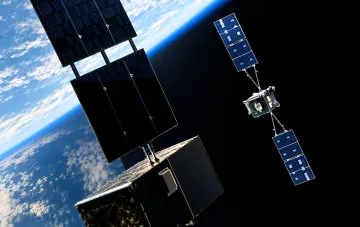
Researchers emphasize that debris fragments in orbit can crash into spacecraft at speeds exceeding 25,700 km/h. At such speeds, even the tiniest fragment carries enough energy to pierce hulls, damage scientific equipment, and injure astronauts, including during spacewalks. This is why hypervelocity impact protection has become a top priority in designing both satellite systems and personal safety equipment for astronauts.
How the Experiment Was Conducted
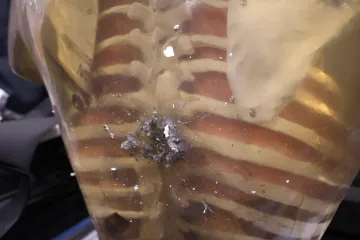
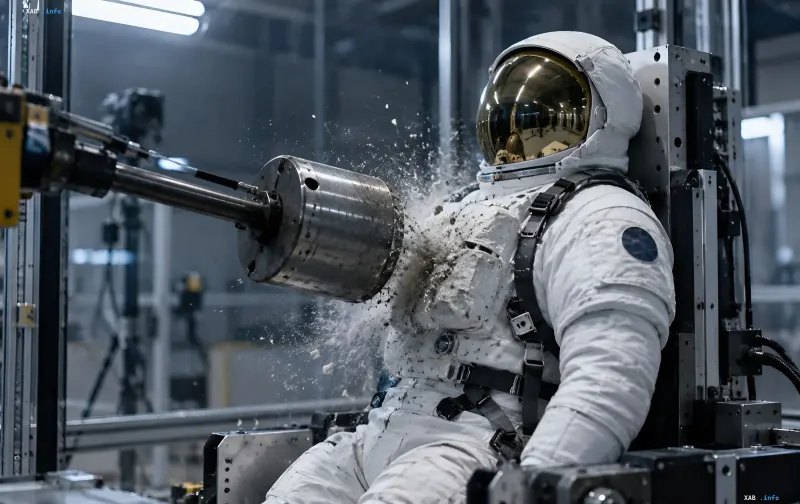
To verify the protective properties of Space Armor, specialists used a hypervelocity testing setup: a 3 mm diameter aluminum sphere was fired at a target at approximately 7.2 km/s, equivalent to roughly 25,900 km/h. A hexagonal Space Armor Lite tile was placed in front of a transparent ballistic torso—provided by Ballistic Dummy Lab—simulating human soft tissue and skeletal structures. This approach evaluated not only the integrity of the shield itself, but also the level of protection afforded to the "tissues" behind it.
Composite vs. Aluminum: What the Results Showed
Following the impact, no visible penetrations or damage were detected on the ballistic torso, and no noticeable cracks or bulging were recorded on the back of the composite tile. For comparison, engineers repeated the experiment by replacing the composite with a solid 4 mm thick aluminum plate while keeping the impact angle, distance, and mounting method identical. In the second case, the debris pierced the aluminum plate and penetrated the dummy material, clearly demonstrating the difference in protective properties between the two materials.
Secondary Fragments: A Hidden Threat
A key conclusion of the comparative tests was the identification of an additional hazard associated with the generation of secondary fragments. During hypervelocity collisions, fragments and shards that breach primary protection become projectiles themselves, capable of injuring humans or damaging sensitive equipment. According to the tests, the Space Armor composite structure reduces the risk of such secondary damage by preventing fragments from passing through to the reverse side.
What's Next: From Lab to Orbit
Atomic-6 is currently exploring the use of Space Armor as additional protection during spacewalks and in environments with a high risk of debris collision. Future research will determine the specific scenarios—from satellite platforms to extravehicular activity gear—where the composite can be moved out of the lab and utilized in real orbital conditions. Thus, successful laboratory tests pave the way for the practical implementation of a new class of hypervelocity armor in the space industry.