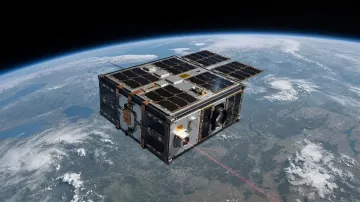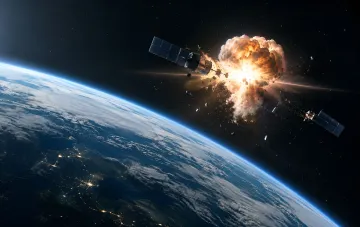
An international team of researchers from the University of Wisconsin and Princeton University has published the results of a large-scale simulation modeling the consequences of a nuclear explosion in low Earth orbit. In the central scenario calculation, a single one-megaton blast at an altitude of 500 km is capable of disabling 98% of the 13,306 modeled operational satellites within seven days. The scientists used real data on satellite positions and orbits as of January 2026, making the simulation results closely aligned with the actual configuration of orbital infrastructure.
Destruction Mechanism: Not a Flash, but a Radiation Belt
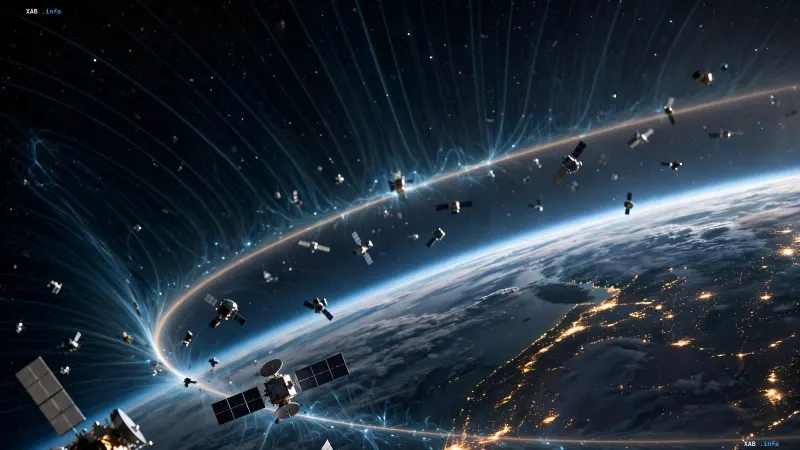
The core conclusion of the study is that the primary destructive force of a nuclear explosion in space is not the initial X-ray flash, but the formation of an artificial radiation belt. The radioactive decay of fission products releases electrons, some of which are captured by Earth's magnetic field and begin moving along magnetic field lines, repeatedly passing through regions where satellites reside. With each crossing, the spacecraft receive an additional dose of radiation until their electronics fail. Unlike the initial flash, which affects only the detonation area, this process damages satellites far beyond the epicenter.
Failure Dynamics: From 2.9% to 98% in a Week
The simulation demonstrates a clear temporal dynamic in the degradation of the orbital constellation. Immediately after the explosion, about 2.9% of spacecraft fail due to direct X-ray radiation. Within 24 hours, the failure rate reaches 25%; in three days, 78%; and in a week, 98%. The authors also tested a scenario with higher radiation resistance for the spacecraft: even in this case, about 72% of satellites become non-operational within a week, and about 97% within 15 days. Thus, even a significant strengthening of electronics cannot prevent the catastrophic loss of the constellation.
Dependence on Detonation Site and Collision Cascade
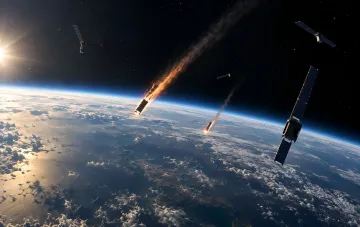
The simulation result depends significantly on the geographical location of the blast. In the chosen scenario, detonation over the South Atlantic creates an especially intense radiation belt intersecting heavily populated satellite orbits. In other regions, electrons may be lost in the atmosphere without forming such a persistent belt. The loss of satellite control creates an additional problem: dead spacecraft remain in orbit and cannot evade close approaches. According to calculations, about 20 collisions will occur in the first two years after the explosion, and approximately 26 over ten years, compared to 12 in the control scenario without an explosion. About 75% of the expected collisions occur in the first year, creating a cascading effect of new debris generation.
Why Launching New Satellites Won't Solve the Problem
Atmospheric drag will eventually pull many damaged spacecraft out of low orbits, but this does not mean a quick recovery of satellite infrastructure. At higher altitudes, debris lingers longer, and radiation can persist for years. Launching new satellites by itself does not solve the problem: they will also have to withstand residual radiation and an increased risk of collisions with debris. The authors emphasize that their work is a model assessment, not a prediction for any specific scenario: the outcome depends on the detonation site, the number of trapped electrons, spacecraft radiation hardness, and adopted assumptions. Nevertheless, the simulation clearly demonstrates that the consequences of a nuclear explosion for orbital infrastructure can be far more extensive than direct destruction of satellites near the epicenter.