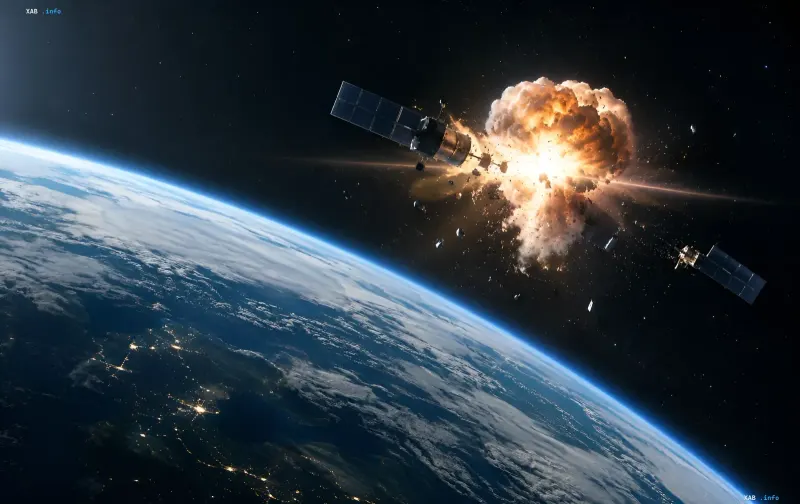
Scientists from the University of Wisconsin–Madison and Princeton University have published a study on the arXiv preprint server simulating the consequences of a single nuclear explosion in high orbit. According to the calculations, the detonation of a 1-megaton warhead at an altitude of 500 kilometers above the South Atlantic Anomaly could disable virtually the entire fleet of satellites in low Earth orbit — more than 13,000 devices providing global communications, internet, and meteorological forecasts. The work, reported by RBC-Ukraine, demonstrates the critical vulnerability of modern orbital infrastructure to a targeted space attack.
Why the South Atlantic Anomaly specifically
The choice of location for the simulated explosion is not accidental. The South Atlantic Anomaly is a region over the South Atlantic where Earth's magnetic field is abnormally weak. According to the researchers' calculations, this weakening of the geomagnetic shield vastly amplifies the consequences of a nuclear detonation: radioactive particles and ionized radiation become trapped in the weakened magnetic field, forming an extensive artificial radiation belt. Satellites regularly passing through this zone would be exposed to continuous radiation, mirroring the mechanism of the 1962 Starfish Prime test — a high-altitude nuclear test that temporarily disrupted several orbital spacecraft and ground electronics.
99.3% of satellites in 30 days: enhanced protection scenario
The researchers accounted for active satellites as of January 2026 and considered even an optimistic scenario in which all devices are equipped with enhanced radiation shielding. Under these conditions, they calculate that 99.3% of satellites would fail within 30 days of the explosion. If a less powerful 100-kiloton warhead were used, neutralizing 99% of the devices would take a full year. Thus, even reducing the yield does not remove the threat to orbital infrastructure — only the timeline of the catastrophe changes.
Cascade collisions and space debris
Radiation, the authors conclude, would not be the only threat. The loss of maneuverability by the first damaged satellites would trigger a chain reaction of collisions in orbit. Scientists estimate about 20 direct collisions during the first two years after the explosion, and over a decade, some 3,900 new fragments of space debris would form in near-Earth space. Restoring orbital infrastructure under such conditions, the researchers estimate, would be an extremely difficult task: new vehicles would have to survive simultaneously amid the residual radiation field and a growing debris cloud.
Context: from Starfish Prime to modern threats
The study fits into a broader context of discussing the risks of high-altitude nuclear tests and their long-term impact on the space environment. The 1962 Starfish Prime test conducted by the US at an altitude of about 400 kilometers already showed that a single explosion could create radiation belts threatening orbital hardware. Modern data on satellite fleet density — over 13,000 devices in low Earth orbit — makes the relevance of such scenarios many times higher than in the 1960s. Publication of the work on arXiv allows the scientific community to independently verify models and calculations before possible consideration in peer-reviewed journals.