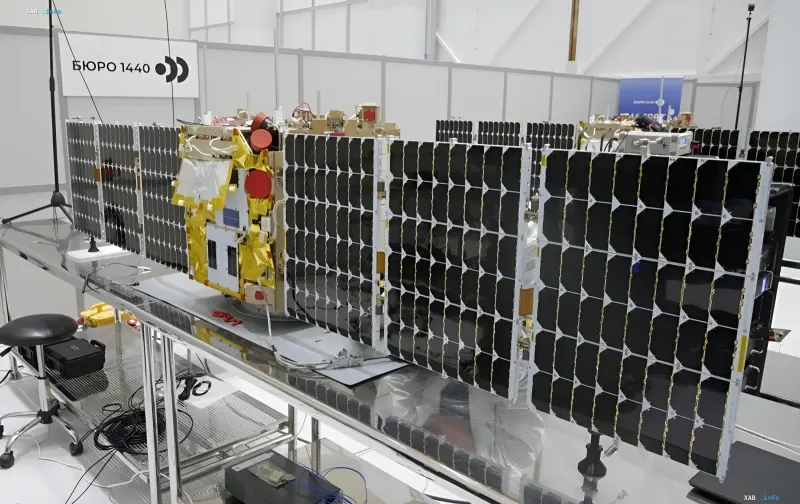
Ukrainian intelligence has released a detailed assessment of the state of the Russian low-orbit satellite communication system 'Rassvet,' which Moscow positions as an answer to the American Starlink. According to data from the press service of the GUR MO (Defense Intelligence of Ukraine), cited by RBC-Ukraine, the project is facing systemic difficulties: from dependence on foreign components and issues with placing the vehicles into target orbit to delays in the development of compact subscriber terminals. The third launch of satellites, planned for 2026, has reportedly been canceled or postponed.
Two launches, two de-orbitings
Russia placed 30 vehicles into orbit in two batches — on March 23 and July 19, 2026. Already two satellites have left orbit. Of the remaining 30 vehicles, 26 have reached a stable position at an altitude of about 500–520 km, while none have reached the planned target altitude of 800 km. Other vehicles, according to the intelligence assessment, continue maneuvers to reach the target orbit. Earlier, on October 30, one of the system's satellites — Rassvet-3 No. 17 — left orbit and burned up in the atmosphere after spending less than three months in space. According to Defense Express, the vehicle likely failed to engage its engine for orbit correction.
Laser channels and a mass of 280 kg
The mass of one satellite is approximately 280 kg. Inter-satellite laser communication is cited as the system's key technology, allowing for traffic transmission directly between vehicles without constant reliance on ground infrastructure. This specific element, according to the developers' design, is meant to ensure network resilience and minimize dependency on ground stations.
The 'Ultra' terminal and plans for 2027–2028
In September 2026, according to GUR data, tests of the 'Ultra' subscriber terminal were completed. The stated download speed is up to 650 Mbps, and device operation is provided even while the carrier is moving at speeds up to 250 km/h. By the end of the year, it is planned to deliver about a thousand such devices to customers. In 2027, development of four more terminal modifications is planned, and in 2028, the 'Vozdukh' aviation terminal is expected to be introduced.
Roadmap to 924 satellites
By the end of 2026, Russia planned to increase the constellation to 47–48 vehicles. In 2027, it is intended to launch another 240 satellites, which should ensure 94% coverage of the Russian Federation with data transmission speeds up to 150 Mbps. By 2031, the constellation is planned to grow to 408 vehicles, and by 2035 to 924 satellites. The ground segment is centered around the main control center in Moscow, which is responsible for satellite monitoring, laser channel operation, and traffic routing, as well as a network of ground stations.
Who is behind the project
The main executor of the project is LLC 'Bureau 1440,' part of 'ICS Holding.' According to intelligence data, at least 46 Russian and three Belarusian companies are involved in industrial cooperation. Thus, 'Rassvet' is a large-scale program with broad industrial cooperation; however, according to GUR estimates, its implementation significantly lags behind the stated timelines and technical parameters.