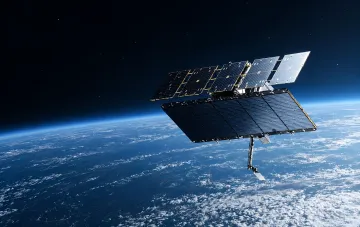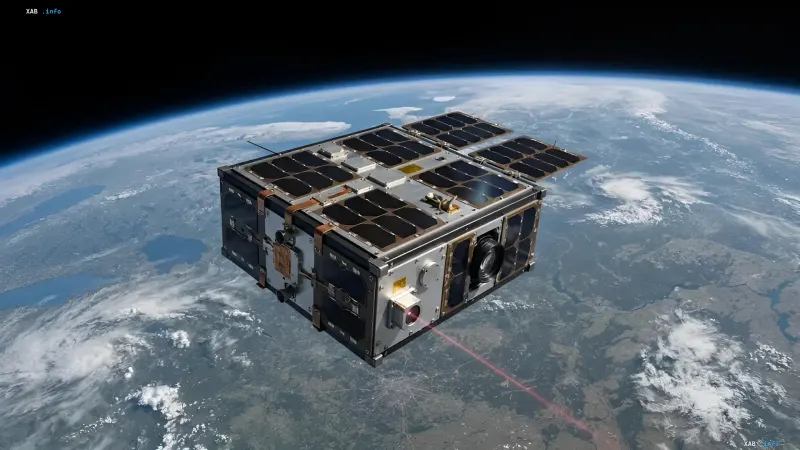
Russian companies Geoscan and KuSpace Technologies have completed testing of a mutual pointing system for satellites and a ground-based optical station designed to organize a laser data transmission channel. The experiment, conducted in November 2026, confirmed that the orientation accuracy of spacecraft on the Geoscan 16U platform is sufficient to establish a stable optical communication channel with Earth. The test results pave the way for the transition of small satellite constellations from traditional radio frequency channels to laser data transmission.
How the experimental setup was organized
The tests were carried out with the participation of two satellites—Lobachevsky and InnoSat16—as well as a ground-based optical station located in Zvenigorod. During the experiment, the station tracked the spacecraft, directing a laser beacon signal at them. Sensor matrices installed on board the satellites captured the incoming laser beam, and engineers assessed pointing accuracy based on the position of the light spot on the receiving elements. This two-way verification scheme made it possible to simultaneously monitor orientation quality from both the satellite and the ground complex side.
Accuracy indicators: 0.011° and 0.003°
Based on the series of measurements, the average orientation error of the satellites toward the ground station was 0.011 degrees, while the deviation when pointing the optical station at the satellites did not exceed 0.003 degrees. Project participants note that these accuracy values are sufficient to form a stable optical communication channel capable of transmitting data at high speeds without significant signal loss. The obtained characteristics confirm the operational capability of the Geoscan 16U platform's component base in laser telemetry mode.
Why laser communication wins over radio frequencies
Laser data transmission has a number of significant advantages over traditional radio frequency channels. First, an optical beam allows for transmitting significantly larger volumes of information at high speeds. Second, the system consumes less energy compared to radio transmission. Third, the narrow focus of the laser beam makes it much harder for third parties to intercept the signal, which increases channel security. Finally, the technology does not require radio frequency licensing, which simplifies and reduces the cost of launching satellites into orbit and their subsequent operation.
Development plans for the direction
Geoscan announced its intention to continue developing the laser communication direction and apply the results obtained during the tests in future small satellite projects. The company views optical telemetry as a key technology for the next generation of compact orbital platforms, which will increase constellation throughput without expanding the radio frequency spectrum. Joint work with KuSpace Technologies as part of this experiment has become an important stage in validating the hardware and software complex, which is planned to be replicated for subsequent launches.