Space science has just concluded one of the longest-running detective stories of recent years. Astronomers, who for nearly two decades had been unable to explain the nature of mysterious radio flares emanating from a specific region of the Milky Way, have finally identified the mechanism behind their generation. The object, catalogued as ASKAP J1745-5051, turned out to be a close binary system in which a white dwarf accretes matter from a neighboring red dwarf, and the interaction of their ultra-powerful magnetic fields produces periodic pulses in the radio range. The discovery, confirmed by data from several observatories across four continents, fills an important gap in our understanding of compact binary systems and puts to rest one of 12 previously catalogued but unexplained sources.
How ASKAP and MeerKAT Tracked the Source
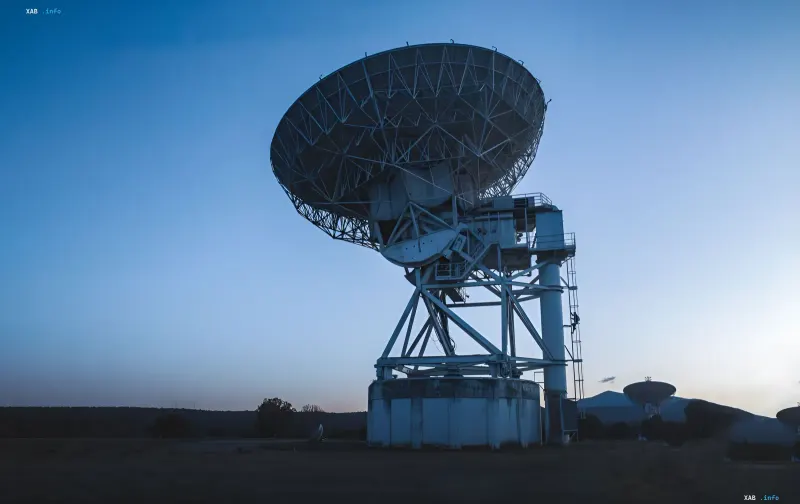
The object was first detected by the ASKAP (Australian Square Kilometre Array Pathfinder) radio telescope, located in Western Australia. Its wide aperture and high sensitivity allowed it to record anomalous radio flares that did not fit standard models of pulsars or magnetars. To refine the coordinates and confirm the periodicity of the signals, the South African MeerKAT interferometer was brought into the effort, its configuration of 64 antennas providing the necessary angular resolution. Optical spectroscopy data obtained from observatories in Chile, along with archival observations from space-based X-ray telescopes, were then added to the analysis. The combination of these measurements enabled researchers to precisely determine the system's structure and rule out alternative hypotheses.
Anatomy of the System: A White Dwarf, a Red Dwarf, and a 1.3-Hour Orbit
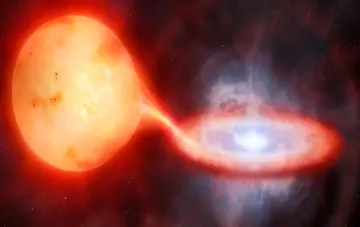
The established configuration of ASKAP J1745-5051 is as follows: a compact white dwarf orbits a red dwarf with a mass of roughly 10 percent of the Sun's mass, with an orbital period of just 1.3 hours. Such closeness means that the distance between the stars is only a few solar radii, making the system extremely dynamic. Matter blown off the surface of the red dwarf forms an accretion stream that falls onto the white dwarf. Upon colliding with its surface or magnetosphere, this stream is heated to extreme temperatures and generates bright X-ray pulses. It was precisely this X-ray emission that became the key 'confirming' channel, allowing the object to be distinguished from pulsars and other compact sources.
Magnetic Loops as the Generator of Radio Flares
The main source of the mysterious radio signals that had baffled astronomers for nearly two decades, however, turned out to be the interaction of the ultra-powerful magnetic fields of both stars. According to the researchers' estimates, the magnetic field strength of these fields is thousands of times greater than the field of a medical MRI scanner. At the point where the magnetic field lines of the two stars cross and close into so-called magnetic loops, periodic reconnection occurs, producing bursts specifically in the radio range. A fundamentally important observation was the time offset between the peaks of the radio and X-ray pulsations: they do not coincide, which unambiguously confirms that the signals are generated in different regions of the binary system, rather than at a single point.
Contradictory Data
When comparing the wording across various publications and news summaries, a minor discrepancy is noted in the chronology of the 'age' of the mystery. The basic scientific description states that astronomers had been unable to explain the phenomenon for 'nearly 20 years,' while a number of news headlines use phrasings such as '20 years of mystery' or 'more than 20 years later.' A difference of a few months does not change the essence of the discovery, but it reflects whether the timeframe is counted from the moment the anomalous signal was first catalogued or from the publication of the first attempt to interpret it. The exact date of the initial detection is not specified in the provided sources, so the XAB.info editorial team records both versions without prioritizing either.
First of Twelve: What Comes Next
ASKAP J1745-5051 has become the first confirmed object of its class — a white dwarf accreting matter from a neighboring star in a close binary system and generating characteristic radio flares through magnetic loops in the process. This is fundamentally important, because of the 12 previously catalogued similar sources, 10 still lack a confirmed mechanism of origin. Scientists have already announced continued observations of the system's X-ray oscillations in order to test whether such magnetic loops are a universal source of other mysterious radio signals recorded in the Milky Way. If the hypothesis is confirmed, it will allow the catalogs to be revised and, possibly, 'close' dozens more undecoded objects with a single mechanism.