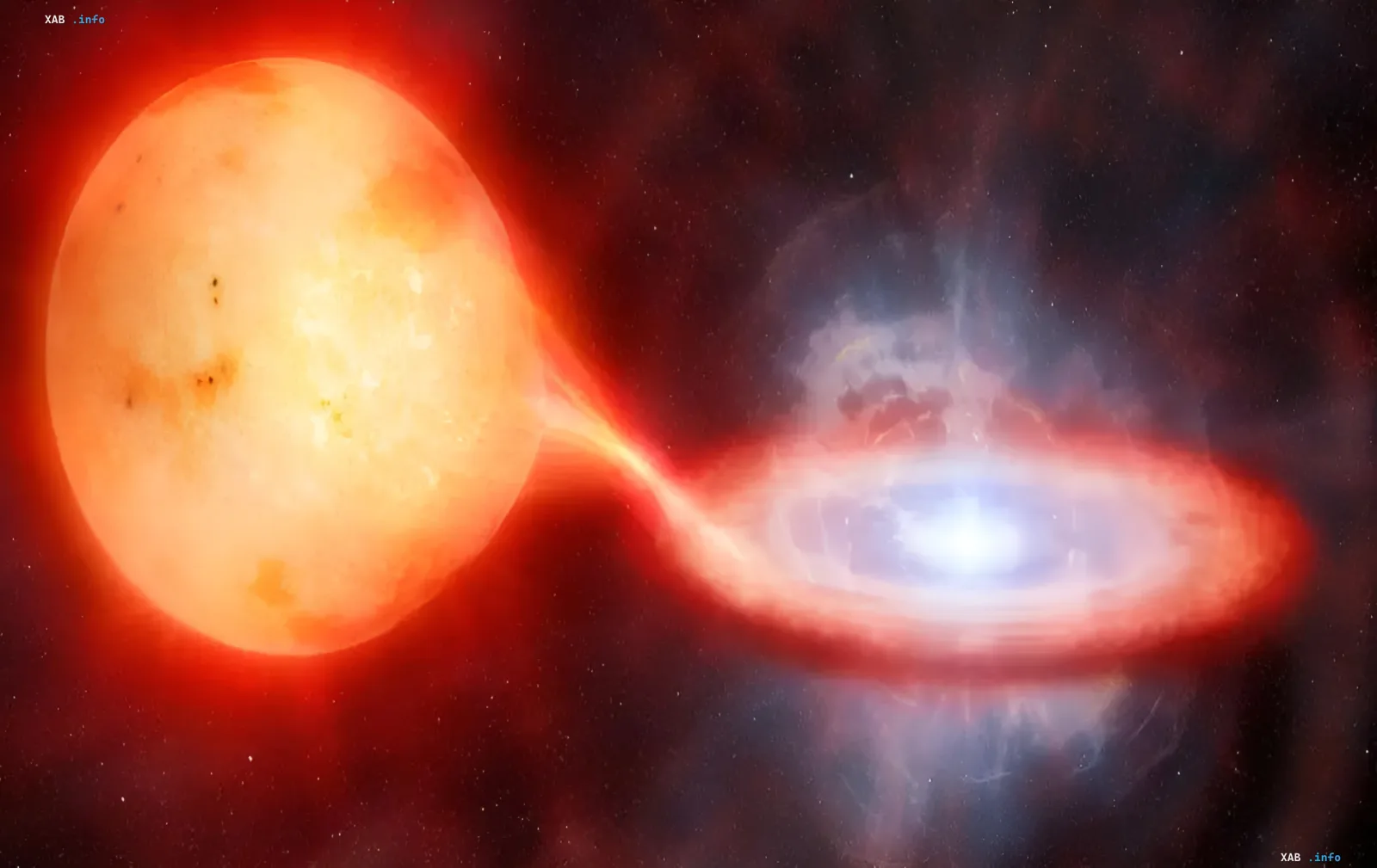
An international team of astronomers led by Aneuryn Evans of the University of the West of England (United Kingdom) has recorded one of the most powerful repetitive nova explosions outside the Milky Way. The observed object is the stellar system LMC 1968-12a, also known as LMC68, located in the Large Magellanic Cloud — a satellite galaxy of our own. Unlike supernovae, which completely destroy a star, novae occur in binary systems where a dense white dwarf gradually pulls matter onto itself from a giant companion. When a critical mass accumulates on its surface, a thermonuclear explosion occurs, after which the cycle begins anew. It is precisely this "repeatability" that makes LMC68 a particularly valuable object for studying the physics of explosions.
An Explosion on Schedule: How the LMC68 System Works
The LMC68 system consists of a white dwarf and a red subgiant and is characterized by a predictable four-year cycle of outbursts: explosions were recorded in 1968, 1990, 2002, 2010, 2016, and 2020. The latest outburst occurred exactly on schedule in August 2024, allowing the scientists to prepare the observational campaign in advance. At the same time, as the researchers note, LMC68 is located about 50 times farther away than novae in our galaxy, so its visual brightness is 2,500 times fainter than that of nearby analogues — which makes the spectra obtained all the more valuable.
Observations in Chile: Spectra Lacking the Usual Elements
The team used the Magellan Baade telescope and the Gemini South observatory in Chile to obtain near-infrared spectra 9 and 22 days after the outburst. The data obtained surprised the researchers: the spectrum almost completely lacked the lines of sulfur, phosphorus, calcium, and aluminum that are typical of such explosions. Instead, a single intense signal from highly ionized silicon, stripped of nine of its fourteen electrons, dominated. Co-author of the study Thomas Geballe called this picture an "unprecedented phenomenon."
Silicon Shining Brighter Than the Sun
During the first observations, the line of ionized silicon in the near-infrared range shone almost 95 times brighter than the combined radiation of the Sun across all wavelengths. Computer modeling showed that the temperature of the ejected gas reached approximately three million degrees Celsius, making LMC68 one of the hottest novae ever recorded by astronomers. It is important to clarify the context of this figure: it refers specifically to the radiation of a single silicon spectral line in the near-infrared range, not to the total visible brightness of the entire star.
Why the Explosion Was So Hot
Scientists highlight two key factors. The first is low metallicity: stars in the Large Magellanic Cloud contain fewer heavy elements than those in the Milky Way. Since heavy elements usually retain heat and promote earlier explosions, their scarcity forces more material to accumulate before detonation, making the final explosion more powerful. The second factor is shock heating: the expanding gas shell from the explosion collided with the outer atmosphere of the massive red subgiant, forming powerful shock waves that further heated the gas.
Significance for Astrophysics
The data obtained constitute the first direct observational confirmation of the shock-heating mechanism in a nova explosion outside our galaxy. This allows astronomers to more accurately calibrate models of thermonuclear explosions in binary systems and better understand how the metallicity of the environment affects the energetics and spectral signatures of novae. Further observations of subsequent LMC68 outbursts, expected on the four-year cycle, should help test the robustness of the derived patterns.