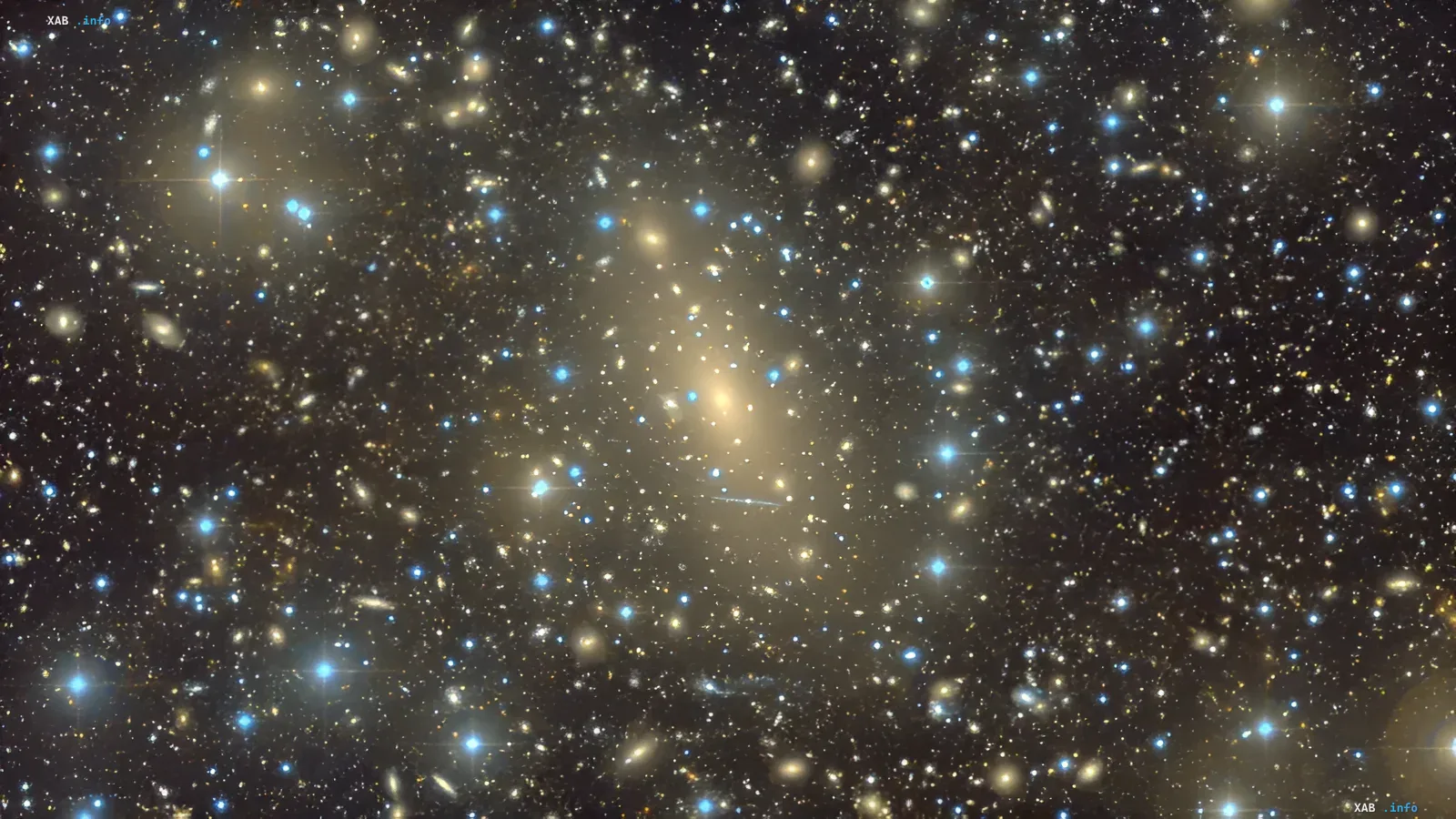
Astronomers have completed one of the most challenging measurements in modern observational astronomy: they have refined the true size of the giant elliptical galaxy IC 1101, located at the center of the Abell 2029 cluster. According to the new estimates, its diameter is about 520 kiloparsecs, or roughly 1.7 million light-years — 17 times the diameter of the Milky Way. This makes IC 1101 the largest known galaxy in both linear size and stellar mass. It is important to emphasize: this is not about the initial discovery of the object, but about the fact that scientists have finally managed to "clean" the data and isolate the extremely faint outer glow of the galaxy, which had previously been lost against the background of intergalactic gas and foreground stars.
How the boundaries of the giant were measured
The main difficulty was not in finding IC 1101 — the galaxy has been known for a long time — but in determining its boundaries. In supergiant elliptical galaxies, the light of the stars at the periphery smoothly dissolves into the faint glow of intergalactic gas and surrounding objects, and the distance to the object — a little over a billion light-years — by no means makes the task easier. For the breakthrough, the researchers used some of the deepest wide-field images of this patch of sky, obtained with the 2.5-meter Isaac Newton Telescope at Spain's Roque de los Muchachos Observatory. The data were then stripped of the scattered light from more than 250 foreground stars, and the turbulence of the Earth's atmosphere was compensated for in order to isolate the galaxy's extremely faint outer halo.
Scales that are hard to grasp
The resulting "cleaned" data allow the stellar mass of IC 1101 to be estimated at roughly 3.4 trillion solar masses — significantly exceeding the stellar mass of the Milky Way. To put it in perspective: if our galaxies were placed one after another along the diameter of IC 1101, about 17 Milky Ways would fit inside it. In essence, the diameter of this giant is comparable to the distance from the Milky Way to the neighboring Andromeda galaxy. Such figures underscore that IC 1101 is not merely a large object, but the pinnacle of the galaxy hierarchy as we know it today.
A galaxy that is still growing
Many signs indicate that IC 1101 formed over billions of years through mergers with other galaxies. Such supergiants grow not so much through the birth of new stars as through the gravitational absorption of their neighbors. Moreover, the galaxy is not fully formed: faint asymmetric structures have been detected around it, indicating ongoing accretion of matter and gradual growth. Scientists describe IC 1101 to some extent as a "galaxy of the future" — the result of evolution in a large galaxy cluster, where in the end only one surviving object remains.
What comes next
The processes in IC 1101 show that the largest structures in the Universe continue to form even billions of years after their birth. The next task for this and other groups of astronomers is to find confirmation by discovering other galaxies of comparable size. For now, IC 1101 remains the record holder, and its story serves as a reminder that even the most "mature" objects in space are far from having completed their evolution.