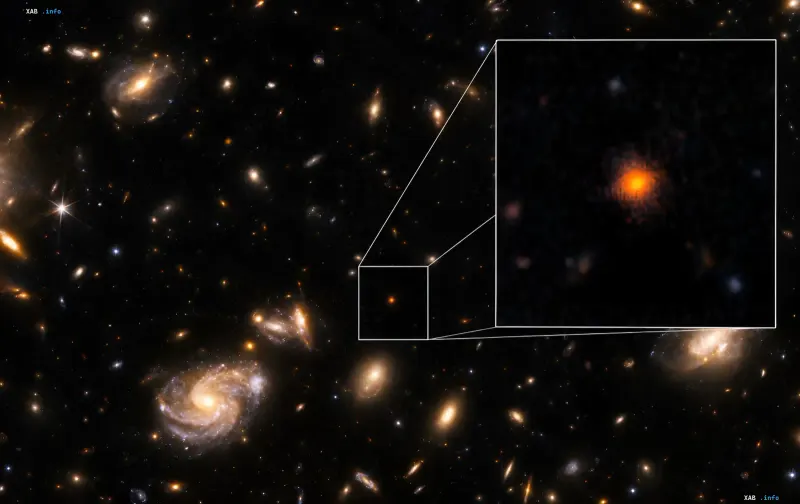
For several years, astronomers believed that an object named Capotauro was the oldest galaxy in the Universe, with light having traveled more than 13 billion years to reach Earth. However, a new study published in the prestigious Monthly Notices of the Royal Astronomical Society has completely revised this conclusion: Capotauro has turned out to be a cold brown dwarf located within the Milky Way, at a distance of about 2,400 light-years from Earth. The error occurred due to the similarity of absorption spectra characteristic of both very distant galaxies and cold substellar objects.
How spectral “disguise” misled scientists
The initial classification of Capotauro as an ultra-distant galaxy was based on the features of its light spectrum. In certain ranges, the object's radiation was absorbed, and this absorption pattern resembled the hydrogen signature of very ancient galaxies located at the edge of the observable Universe. It was this resemblance that led researchers to conclude it was at a record-breaking distance. However, as subsequent observations showed, cold brown dwarfs are capable of “pretending” to be distant galaxies precisely due to similar broad absorption bands in the spectrum, making them extremely deceptive false candidates when searching for early Universe objects.
The decisive role of JWST observations: a 0.13 arcsecond shift
Key evidence that debunked the hypothesis of Capotauro's galactic nature was a comparison of images obtained by the James Webb Space Telescope (JWST) in December 2022 and June 2026. Over the 3.5-year interval, the object shifted by 0.13 arcseconds relative to background stars. Such proper motion unequivocally indicates that Capotauro is located inside our Galaxy. If it were truly the oldest galaxy at the edge of the observable Universe, its angular movement over such a short period would be imperceptible to any existing telescope.
What Capotauro actually is
According to new calculations, Capotauro is a Y-type brown dwarf, one of the coldest classes of substellar objects. Its surface temperature is around 350 Kelvin, equivalent to approximately 77 degrees Celsius. Located at a distance of about 2,400 light-years from Earth, it is among the most distant objects of this class ever discovered by astronomers. This makes it a valuable subject for studying the distribution and physical properties of the coldest substellar bodies in the Milky Way.
Methodological conclusions for cosmology
Although Capotauro did not rewrite the history of the formation of the first galaxies, the discovery itself is significant for cosmological methodology. The study's authors urge the mandatory inclusion of cold brown dwarf templates in identification algorithms when searching for ultra-distant early Universe objects. Without such accounting, there is a real risk of repeating such errors, where galactic substellar objects are mistakenly classified as galaxies at extreme distances. The work demonstrates that even when using a powerful instrument like JWST, cross-validation of data from different observation eras remains an indispensable verification tool.
The significance of the discovery for astrophysics
Despite the fact that the sensational status of the “oldest galaxy” has been removed, Capotauro provides astronomers with important data on the distribution and properties of the coldest substellar objects in the Milky Way. The detection of a Y-type brown dwarf at a distance of 2,400 light-years expands the known sample of such bodies and allows for the refinement of models of their formation and evolution. Furthermore, the case of Capotauro serves as a clear example of how the development of observational capabilities—in this case, repeat JWST shots with an interval of several years—allows for the rapid and reliable resolution of disputed classifications that would have previously remained irrefutable.