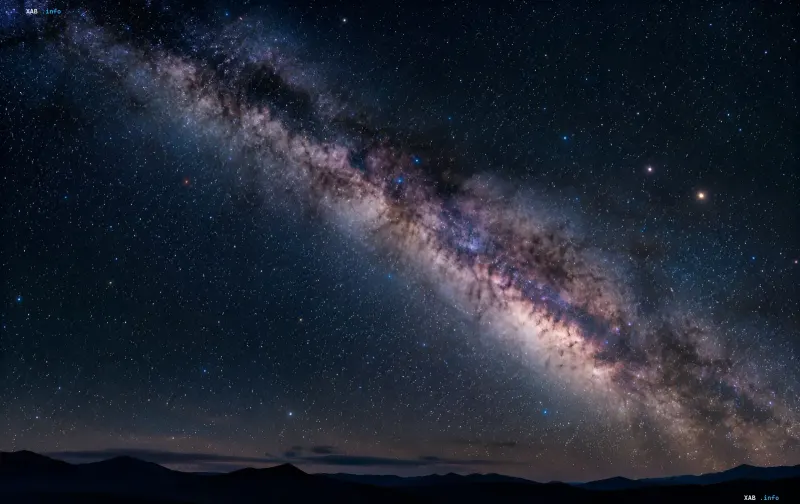
Astronomers have presented the most accurate estimate of our galaxy's total mass to date, combining data from the DESI project and the Gaia space telescope. According to a new study published on the arXiv preprint server, the total mass of the Milky Way, including normal and dark matter, is 1.19 trillion solar masses with an uncertainty of about 11 percent.
Challenges of Previous Mass Calculations
Previous scientific works relied on significantly different methodologies, leading to a wide spread in final figures. Some research groups studied distant stars in the outer galactic halo, while others focused on analyzing stellar streams and globular clusters. Meanwhile, newer models of galactic disk rotation often yielded lower figures compared to observations of distant cosmic objects.
The main methodological difficulty for a long time was the lack of comprehensive testing of multiple approaches simultaneously. Scientists did not always correctly account for gravitational jumps and the influence of invisible dark matter, which accounts for the vast majority of the galaxy's mass. Because of this, a significant gap existed between local and global estimates of the Milky Way's structure.
The New Approach by the DESI Team
To overcome these difficulties, the DESI team conducted a large-scale analysis of more than 10,000 distant stars located at distances from 30,000 to 310,000 light-years from the galactic center. The obtained data were compared with high-precision stellar motion measurements from the Gaia space observatory. The researchers applied four independent modeling approaches simultaneously.
Before performing the final calculations, each of the four methods underwent rigorous testing on artificial simulations of six model galaxies. This approach helped identify and eliminate systematic errors, ensuring high reliability of the final result. For the inner part of the Milky Way within 260,000 light-years from the center, the measurement error dropped to a record 8 percent.
Significance of the Discovery for Astronomy
The findings convincingly confirm the existence of a massive outer halo around our galaxy, but also indicate the need to adjust theoretical models. The simulations showed that in the future, astronomers will have to account for a less spherical and more gravitationally unstable shape of the Milky Way. Soon, the research team plans to open full access to the DESI data set, allowing independent research groups to continue studying our star system's structure.