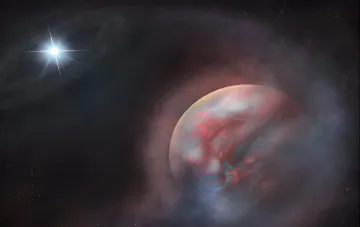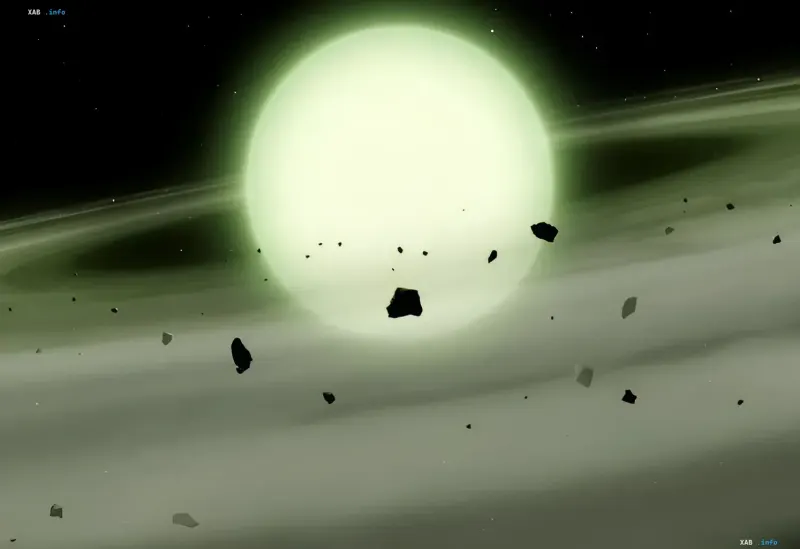
Astronomers have recorded the first-ever detection of a white dwarf emitting a faint green light. The star, cataloged as WD J1330+6435, is located in the Milky Way at a distance of approximately 280 light-years from Earth in the constellation Draco. According to the standard model, a star's color is directly linked to its surface temperature: cooler objects appear orange or red. However, white dwarfs can exhibit non-standard hues driven not by temperature, but by the chemical composition of their atmospheres. According to researchers, this exact mechanism is responsible for the unusual glow of WD J1330+6435.
A Dense Core the Size of Earth
White dwarfs are dense cores left behind after a low- or medium-mass star exhausts its thermonuclear fuel and sheds its outer layers. Although the mass of such an object is frequently about half the mass of the Sun, its diameter is roughly equal to that of Earth. Astrophysicists emphasize that our own Sun will also complete its evolution as a white dwarf in a few billion years, making the study of such objects both an academic and a practically significant direction.
Sodium That «Steals» Orange
Lead study author and astrophysicist Mark Hollands from the University of Warwick (UK) explained the mechanism behind the green tint. Under normal conditions, sodium atoms absorb light with a characteristic orange wavelength—which is why sodium-vapor streetlights emit a yellowish-orange glow. However, inside a white dwarf, the environment is extremely dense: sodium atoms constantly interact with surrounding helium atoms, altering their energy levels and absorption spectrum. Instead of a narrow orange band, sodium in WD J1330+6435 absorbs light across multiple ranges simultaneously—in the yellow, orange, and partially red regions of the spectrum. As a result, the remaining light reaching the observer acquires a pronounced green tint.
Planetary Debris as a Trigger
According to Hollands, scientists' attention was drawn to WD J1330+6435 by the detection of planetary material falling onto the star's surface. This process led to a sharp increase in the concentration of several elements in the outer layers of the atmosphere, primarily calcium, lithium, and, most importantly, sodium. The study was published in the journal RAS Techniques and Instruments and, according to the authors, demonstrates how a star's interaction with the remnants of planets that once orbited it can radically alter the object's observed spectrum.
«Like Mixing Paints in Art»
Astrophysicist Boris Gänsicke compared the observed effect to mixing paints in art: when some pigments are removed from a palette, the final color visible to the observer changes fundamentally. Similarly, sodium's absorption of a wide spectrum «subtracts» the orange and yellow components from the white light, leaving green in the foreground. The discovery expands our understanding of how the chemical evolution of a white dwarf's atmosphere, triggered by the accretion of planetary material, can generate visually unique objects that do not fit standard temperature classifications.