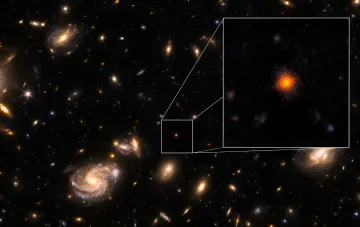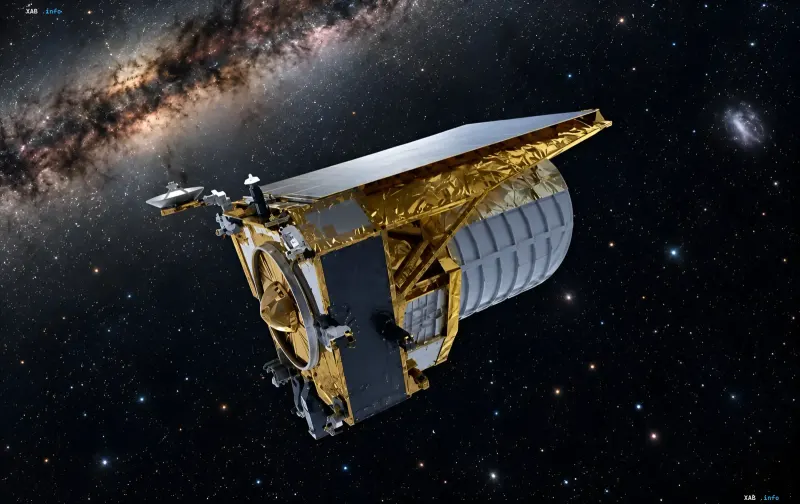
The European space telescope Euclid has recorded the oldest and most distant quasar in observational history. Designated J1504+6252 and given the informal name Dún Aonghasa, the object was singled out among millions of sources in data gathered by the spacecraft over 18 months of operation. The results have been published in the scientific journal Astronomy & Astrophysics. The quasar was captured in the state it was in 13.1 billion years ago — 40 million years earlier than the previous record-holder among the oldest quasars.
Confirmation by multiple observatories
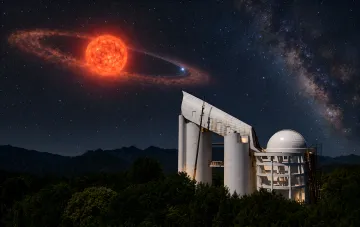
Following the initial detection, other telescopes — Keck, the Large Binocular Telescope, Hubble, and James Webb — joined in studying the object. JWST data in particular made it possible to determine the mass of the supermassive black hole at the center of the quasar: approximately 360 million solar masses. Such cross-analysis across different wavelengths and apertures increases the reliability of the measurement and eliminates single-instrument artifacts.
How a quasar works
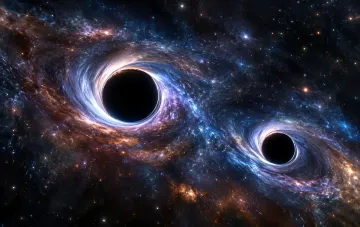
Quasars occur when huge amounts of gas and dust surround a supermassive black hole, serving as its food source. Driven by powerful gravity, the material forms an accretion disk that glows brightly and ejects jets of plasma. During this short phase, the active galactic nucleus can shine brighter than all the stars in the surrounding galaxy combined, making such objects visible across cosmological distances.
Two riddles of Dún Aonghasa
The primary scientific value of the discovery lies in two counter-intuitive details. The first is excessively rapid growth: it was previously thought that a black hole needs about a billion years of matter absorption and mergers to reach supermassive status, whereas Dún Aonghasa reached 360 million solar masses just 630 million years after the Big Bang. The second is slow feeding: unlike other known black holes of that era, this object is consuming gas and dust relatively slowly, meaning that its period of rapid saturation has either already ended or been put on pause.
The context of the early Universe
By looking back 13.1 billion years, Euclid captured a critical period in cosmic history: at this time, the first stars and galaxies were forming, and the dispersal of cosmic gas was bringing the Universe's "Dark Ages" to a close, allowing light to travel freely. The primary mission of the telescope, launched in 2023, is the study of dark energy and dark matter, which account for about 95 percent of all matter and energy in the Universe.
Significance for cosmology
The discovery of Dún Aonghasa, alongside the detection of at least 12 other objects aged around 13 billion years, could fundamentally alter scientific understanding of how the first black holes arose and grew. If supermassive cores truly formed faster than the standard model predicts, it will require a revision of early galaxy evolution scenarios and black hole growth mechanisms in the first few hundred million years after the Big Bang.