A New Era of Radiation Safety in Deep Space
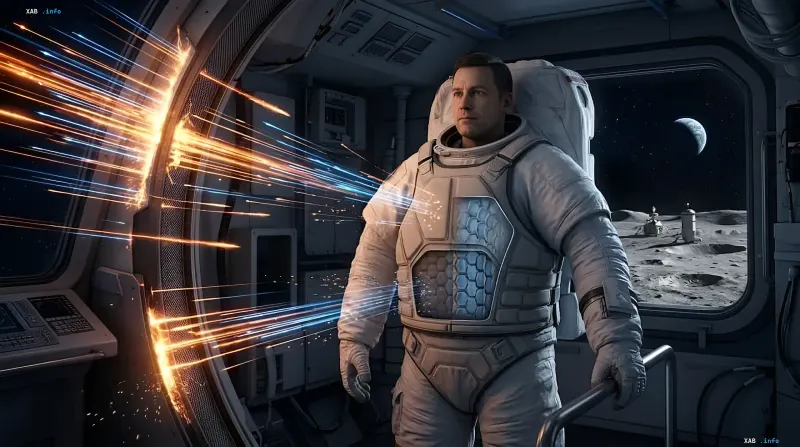
In the context of preparing for ambitious missions beyond Earth's magnetosphere, the problem of ionizing radiation remains one of the primary obstacles to long-term human presence in space. According to data published on August 16, 2026, an international group of scientists, in collaboration with companies StemRad and Lockheed Martin, presented the results of testing an innovative personal protective device — the AstroRad vest. This device aims to solve a critical task: protecting the most vulnerable human organs from sudden radiation spikes during Solar Particle Events (SPE) without limiting the crew's mobility.
Traditional protection methods, such as using heavy lead shields or creating special radiation shelters inside the spacecraft, have significant drawbacks. They are either too heavy to launch or isolate astronauts from performing their duties at critical moments. AstroRad offers a fundamentally different approach: local protection of vital organs with the ability to move freely around the station or spacecraft.
Hydrogen Shield Technology and Segmented Construction
The key component of the vest is hydrogen-containing high-density polyethylene. The choice of this material is not accidental: hydrogen is the most effective element for interacting with charged particles of cosmic radiation, scattering their energy without creating secondary radiation, which often occurs when using heavy metals. To ensure necessary flexibility and ergonomics, engineers divided the material into hexagonal segments of varying sizes. This "armored" structure allows the vest to fit snugly against the body, distributing the load and not restricting movement.
The first prototype version of the vest weighed about 26 kilograms, which is a significant load for an astronaut, especially in low-gravity conditions. However, thanks to construction optimization and the use of new composites, by 2026 engineers managed to reduce the device's mass to 16 kilograms. Experts note that further weight reduction is a priority for future versions to make wearing the vest comfortable for extended periods.
Protection Effectiveness in Solar Storm Scenarios
The effectiveness of AstroRad was tested by simulating historical solar events. In the scenario of the powerful solar storm of August 1972, considered one of the strongest in recorded history, the vest demonstrated impressive results: it reduced the effective radiation dose by 60%, lowering it from 222.3 mSv to 87.5 mSv. This allowed the radiation level to remain within the safety standards set by NASA.
However, results varied depending on the radiation characteristics. During the simulation of the October 1989 solar event, which was characterized by a harder energy spectrum, the protection efficiency was 38.5%. This is explained by the fact that high-energy particles have greater penetrating power and penetrate deeper into the protective material. Nevertheless, even in this scenario, the vest helped keep the radiation dose below critical thresholds, preventing acute radiation sickness.
Application Strategy: Emergency Measure, Not Constant Protection
It is important to understand that AstroRad is not designed to protect against constant Galactic Cosmic Radiation (GCR), which represents a background noise of high energies permeating the entire Solar System. The vest is considered exclusively as an emergency measure, activated during dangerous hours of solar storms. Unlike stationary shelters, which require the crew to stop work and wait for the storm to pass, AstroRad allows astronauts to remain at their posts, control spacecraft systems, and perform necessary maneuvers even under conditions of increased radiation hazard.
Contradictory Data
Although the test results look promising, there are discussions within the scientific community regarding the practical applicability of such solutions. On one hand, proponents of the technology point out that reducing the mass to 16 kg makes the vest acceptable for use in microgravity conditions. On the other hand, critics note that even 16 kg is a significant load that can fatigue the crew during prolonged wear, and the protection efficiency against a hard radiation spectrum (as in the 1989 case) remains insufficient for a full safety guarantee during ultra-powerful events that could exceed historical records.