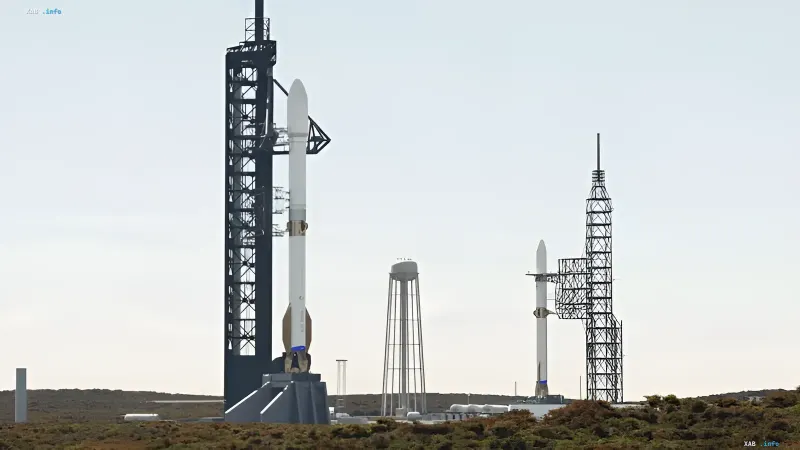
In August 2026, Blue Origin unveiled a massive plan to restore and expand infrastructure at Cape Canaveral. Following a catastrophic accident in May of this year, the company made the strategic decision not merely to restore lost capacity but to double it. Based on the US Space Force-owned Launch Complex 36 (LC-36), two pads will now operate: the restored LC-36A and the newly constructed LC-36B.
New Architecture and Super-Heavy Modification
The key element of the expansion is the creation of the second pad, LC-36B, designed to service the prospective super-heavy modification of the New Glenn launch vehicle, designated 9×4. This configuration, first announced by the company in December 2025, represents a significant leap in Blue Origin's capabilities. The 9×4 designation reflects fundamental changes to the propulsion system: the first stage will be equipped with nine methane-fueled BE-4 engines instead of seven, and the second stage with four hydrogen-fueled BE-3U engines instead of two.
According to Blue Origin engineers' calculations, the new version of the rocket will be able to deliver more than 70 tons of payload to low Earth orbit, over 14 tons to geostationary orbit, and more than 20 tons to a lunar transfer trajectory. To accommodate the increased payload, the diameter of the payload fairing will be expanded from 7 to 8.7 meters.
Hybrid Assembly Scheme and New Infrastructure
Along with the LC-36B launch complex, the company is building a specialized Vertical Integration Facility (VIF) and a new Payload Processing Facility (PPF). The latter is being created in conjunction with the US government and will be capable of servicing both New Glenn versions and payloads from other participants in the launch program at the Eastern Range.
The rocket preparation process will undergo significant changes. Blue Origin is switching to a hybrid assembly scheme: rocket stages will be mated horizontally, after which the assembled vehicle is transported to the launch pad. There, a crane will erect the rocket into a vertical position, and only then will the payload be installed. This approach aims to simplify ground infrastructure and accelerate turnaround between launches, which is particularly relevant after the New Glenn 7×2 transporter-erector was destroyed in the May accident.
Recovery Timelines and Priorities
Despite the scale of construction work, Blue Origin maintains optimistic forecasts. Company CEO Dave Limp stated that restoring the LC-36A pad and resuming launches remain the top priority, with the company planning to return to flight operations by the end of 2026. Currently, exact completion dates for the construction of the second pad, LC-36B, are not specified, although work is proceeding at an accelerated pace.
A swift return to operations is of strategic importance to the US. Since Blue Origin is deeply integrated into NASA's new lunar program, the continuity of launches is viewed as a matter of national interest. Having two launch positions will ensure necessary infrastructure resilience, allowing the complex to continue operations even during repair or maintenance periods for one of the pads.