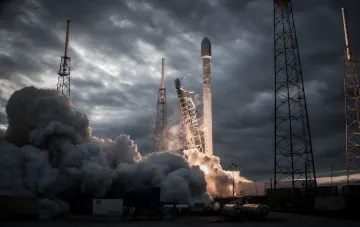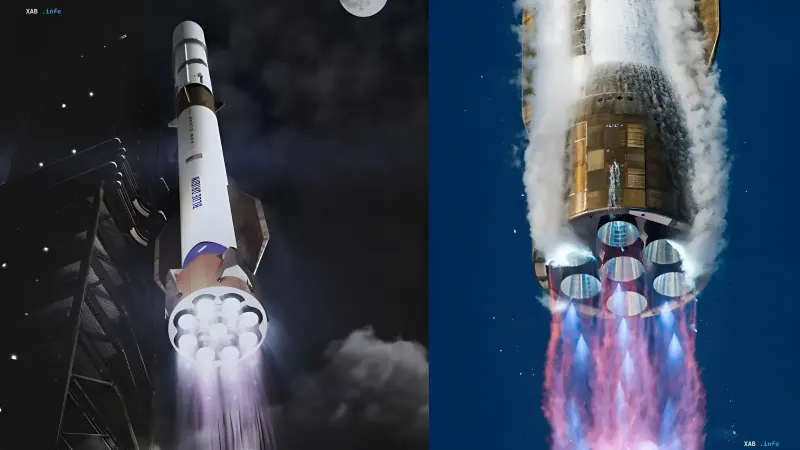
Blue Origin has announced a large-scale program to scale up production and launch capabilities for the New Glenn rocket, aiming to reach a cadence of multiple launches per week by the late 2026s. To achieve this plan, the company is investing $330 million to expand its Florida manufacturing complex, building new facilities for payload preparation and reusable booster maintenance. Blue Origin's total investment in the state's infrastructure has already exceeded $3 billion, and its operations span more than 20 sites across Brevard and Orange counties, employing over 5,000 staff and working with more than 500 suppliers.
Production: 150 Upper Stages Annually
The centerpiece of the expansion program is the approximately 127,000 m² Rocket Park manufacturing complex, located immediately adjacent to NASA's Kennedy Space Center. Upon completion of work scheduled for the summer of 2027, the facility will be capable of producing up to 150 New Glenn upper stages in the 9×4 configuration annually. The production facility will be equipped with automated machining, welding, material handling, and quality control systems. Additional capabilities for chemical processing, payload fairing preparation, tooling fabrication, and component storage are designed to accelerate parts through the manufacturing cycle. Blue Origin aims to manufacture the majority of components and systems in-house, minimizing reliance on external contractors.
Launch Infrastructure: From LC-36A to New Pads
In parallel with production, the company is developing launch infrastructure at Cape Canaveral. Launch Complex 36A, which was damaged in an incident in early 2026, is undergoing restoration. LC-36B will be utilized for New Glenn launches in the 9×4 configuration and will also support the 7×2 variant, including national security missions. Blue Origin has already requested regulatory permission to increase the allowable annual launch frequency from LC-36 from 12 to 50. In addition, supplementary launch pads are planned along Florida's Space Coast to physically support the stated pace of multiple launches per week.
Parallel Mission Preparation: The Key to Frequency
One of the main challenges in commercial spaceflight that Blue Origin intends to solve is not just building more rockets, but simultaneously preparing multiple missions and shortening the turnaround time for reusable stages. To achieve this, the company, in cooperation with the U.S. Space Force, is building a payload integration complex at the spaceport featuring four payload processing bays, two fairing installation bays, and a dedicated area for joint processing of multiple payloads. Another vertical integration facility under construction will allow parallel processing of the rocket and payload, eliminating sequential bottlenecks in the pre-launch cycle.
Booster Recovery: Jacklyn Platform and New Facilities
Increasing flight frequency directly depends on the speed at which Blue Origin returns New Glenn first stages to service. To refurbish them, the company is developing infrastructure at Port Canaveral, where the offshore landing platform Jacklyn is already operating, and is developing two additional identical platforms. The new vertical integration facility will be used to inspect returned boosters and prepare them for refurbishment prior to subsequent missions. The company's manufacturing and logistics facilities in Cocoa, Melbourne, Orlando, and Titusville handle parts fabrication, thermal protection systems, tooling, material processing, and component logistics.
Strategic Context
Blue Origin's ambitious plan to achieve multiple New Glenn launches per week positions the company as a key player in the heavy-lift market, competing with SpaceX and other operators. The scale of investment — over $3 billion in Florida — and the creation of thousands of jobs make the program not only a technological endeavor but also a significant economic project for the region. Successful implementation of the plan by the end of the decade will allow Blue Origin to offer customers regular and predictable access to heavy orbital delivery, which is critical for national security missions, commercial satellite constellations, and future lunar programs.