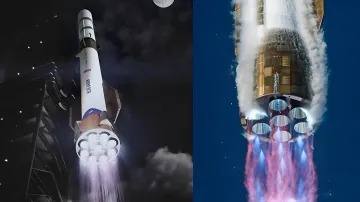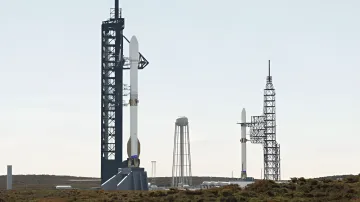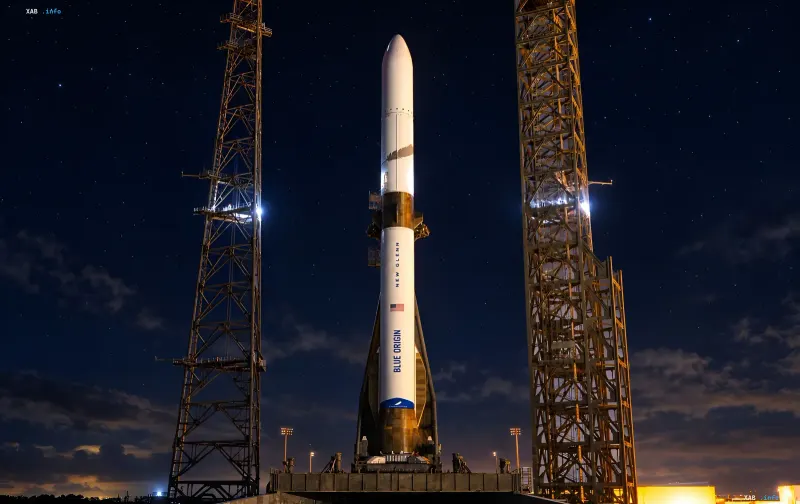
Blue Origin has announced preparations for a massive upgrade of its New Glenn launch vehicle, which is expected to significantly reduce the cost of space launches and expand the range of available missions. The modified version of the rocket will be able to deliver significantly more payload to geostationary orbit and carry out cargo delivery missions to the Moon. According to the company's plans, the first launch of the upgraded configuration with a third stage is scheduled for 2028 under a government contract.
Transition to the Northstar Engine: Simpler and More Powerful
A key technological change in the New Glenn architecture will be the replacement of the first-stage engine. The current BE-4 power plant will be replaced by the new Northstar engine, which, according to Blue Origin CEO Dave Limp, represents "a simpler yet more powerful version of its predecessor." The simplified design aims to reduce production costs and speed up the rocket launch preparation cycle. The company expects that in the future, assembling each Northstar engine will take less than a day—a metric that fundamentally distinguishes the new approach from the months-long production cycles of traditional rocket engines.
Fate of the BE-4: Production Will Continue for ULA
At the same time, Blue Origin is not abandoning the production of BE-4 engines. Their manufacturing will continue for United Launch Alliance (ULA), which uses the BE-4 as the primary power plant for its Vulcan rocket. Thus, Blue Origin retains its role as an engine supplier to a domestic market competitor, providing additional revenue and reducing risks associated with a complete transition to the new platform.
The GS3 Third Stage: Composite Tanks and Moon Missions
The second significant element of the upgrade will be the creation of the GS3 third stage, fueled by liquid hydrogen and oxygen. The stage is equipped with a BE-7 engine and is designed to deliver satellites directly into geostationary orbit, as well as send cargo onto a lunar trajectory. Structurally, the GS3 is made of ultra-lightweight composite materials. Historically, the main problem with such tanks remained the risk of hydrogen leakage when operating under elevated pressure. However, Blue Origin specialists announced the successful testing of a 5.5-meter composite tank, removing a key technological limitation for the serial application of this technology.
Specifications and Payload Plans
Thanks to the introduction of the GS3 stage, the upgraded New Glenn rocket will be able to deliver up to 14 metric tons of payload to geostationary orbit and up to 20 metric tons to a lunar trajectory. These figures make New Glenn one of the highest-capacity carriers in the commercial segment and allow the company to compete for contracts previously available to only a limited circle of players. In the long term, Blue Origin intends to perform more than 1,000 New Glenn launches per year, which will require the creation of powerful manufacturing and logistics infrastructure at the spaceport.
Context: Competition and SpaceX Dependency
Blue Origin's announced plans come amid growing discussions about the U.S. space program's dependence on SpaceX. It was recently reported that NASA's astronaut moon landing was threatened due to limited launch capabilities. In this situation, the emergence of an alternative carrier with high payload capacity and frequent launch capabilities is of strategic significance for diversifying the U.S. launch base. If Blue Origin manages to meet the stated timelines and performance metrics, New Glenn will become a full-fledged competitor to Falcon Heavy and Starship in the heavy and super-heavy launch segments.