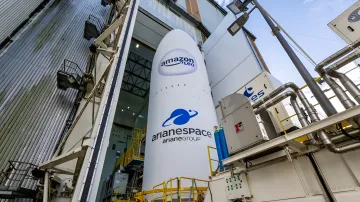
On 24 November 2026, an Ariane 6 launch vehicle lifted off from the Kourou spaceport in French Guiana, placing 36 satellites of the Amazon Leo internet constellation into orbit. Mission VA271, which Amazon designates as LE-04, became the fourth Arianespace launch for this network and the tenth flight in the history of the Ariane 6 vehicle. The rocket launched at 15:22 Moscow time after a half-hour delay, and the flight began nominally. Separation of the last satellite is scheduled for approximately two hours after launch, which is consistent with the standard deployment scheme for Leo constellation vehicles.
First flight in the most powerful configuration
This launch used the most capable version of the vehicle — the Ariane 64 with four P160C solid rocket boosters. This was the first flight of Ariane 6 with the new P160C boosters in its maximum configuration: each of them holds 14 tonnes more propellant than the P120C boosters that had equipped the rocket previously. It was precisely this upgrade that allowed the payload capacity to be increased and 36 vehicles to be placed into low Earth orbit at once — more than in the two previous missions for Amazon, in which the rocket deployed 32 satellites each.
Why the launch is critically important for Amazon
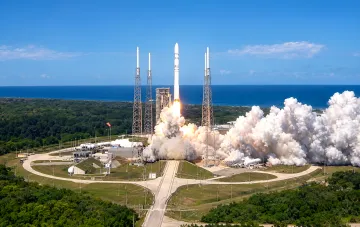
For Amazon, this flight carries special significance, as the company is simultaneously facing serious problems with two other rocket suppliers. On 15 November, a Vulcan launch vehicle from United Launch Alliance (ULA) suffered an accident and failed to place 40 Leo satellites into orbit. This became the first complete mission failure in ULA's history since the company's founding in 2006. Prior to that, Vulcan had been grounded for most of 2026 following a malfunction in one of its solid rocket boosters, detected during a February launch.
Loss of New Glenn and schedule slippage
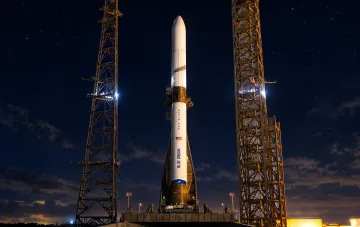
Problems also arose at Blue Origin. The fourth New Glenn rocket, intended to launch 48 Amazon Leo satellites, was destroyed along with part of the launch infrastructure during an explosion on the pad while testing BE-4 engines. No satellites were aboard the vehicle at the time of the incident. Blue Origin now expects to return to flight only in early 2027, which further narrows the window of available launches for Amazon.
Race for orbital slots
Initially, in 2022, Amazon ordered 18 launches from Arianespace, 38 Vulcan launches from ULA, and 12 New Glenn launches from Blue Origin. The company later increased its New Glenn order to 24 batches of satellites and purchased additional Falcon 9 launches from SpaceX; the three originally ordered Falcon 9 flights took place in 2025. Under the terms of a decision by the US Federal Communications Commission, Amazon must deploy its entire first-generation constellation by 30 July 2029. After losing satellites on Vulcan and the postponement of New Glenn's return to flight to 2027, the company must make up the lost ground, with launch availability becoming one of the project's main constraints.
Scale of the constellation
Following the successful completion of mission VA271, the number of Amazon Leo satellites deployed by Arianespace will reach 136, and the total number of constellation vehicles in orbit will be 432. The complete first-generation system is to comprise 3,232 satellites. In October 2026, Amazon reported that it had already produced its thousandth vehicle at its facility in Kirkland (Washington state), underscoring the pace of production against limited launch capacity.