Accumulated debt in the electricity balancing market has become a systemic barrier to attracting investment in new maneuverable generation, without which the stable operation of the Ukrainian power system under regular infrastructure attacks is becoming increasingly vulnerable. This was stated by Ukrenergo Management Board member Ivan Yurik in a commentary published by RBC-Ukraine. According to him, the problem is not limited to a one-time repayment of existing obligations: it is necessary to ensure a mechanism for timely settlements with market participants so that the cycle of "debt - lack of funds - payment disruption" does not repeat from quarter to quarter.
Root of the Problem: Non-payment by Consumers under Special Regime
Yurik pointed out that the main source of accumulated non-payments remains consumers operating under a special disconnection regime: water utilities, mines, and enterprises in frontline territories. Their debt limits Ukrenergo's ability to settle accounts with balancing market participants in a timely manner. As a result, a vicious cycle is formed: the power system does not receive payment for balancing services, cannot return funds to generators, and they, in turn, do not see the economic feasibility of investing capital in new maneuverable capacity. "It is impossible to attract them without solving the problem of debts in the balancing market," the board member emphasized.
Infrastructure Attacks Exacerbate the Need for Flexibility
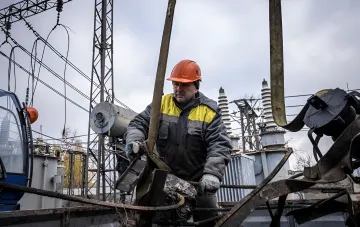
The context in which this warning is issued determines the urgency of the issue. Since the start of the full-scale invasion, according to Yurik, almost all Ukrenergo substations have suffered damage of varying severity, and new shelling daily creates additional needs for the restoration of equipment and networks. "Each new attack means additional needs for equipment and funds for recovery. Timely supplies of scarce equipment from international partners help us return damaged facilities to operation faster," he noted. In such conditions, maneuverable generation capable of quickly compensating for power losses becomes not just an economic but an infrastructural imperative.
Figures: Record Debt in the Market
The scale of the problem is confirmed by data previously voiced by the Chairman of the Management Board of Ukrenergo, Vitaliy Zaichenko: as of now, the debt of balancing market participants to Ukrenergo has exceeded 46 billion UAH, which is one of the highest figures in the history of the market's operation. For comparison: in 2025, this figure grew by 21% — to a record 42 billion hryvnias. At the same time, Ukrenergo's own debt to balancing market participants has also increased significantly — by 36%, to 22.9 billion UAH. Thus, the problem is two-sided: non-payments are accumulating both on the part of consumers and on the part of the network company itself, creating a cascading effect throughout the settlement chain.
Integration into the European Market as a Condition for Change
Yurik also emphasized that debt repayment and halting the accumulation of new debt are not only internal but also geopolitical conditions: without this, Ukraine will not be able to fully integrate into the balancing segments of the European energy market. Expanding the possibilities for exchanging reserves with European partners will allow for more effective balancing of the power system and reduce dependence on domestic maneuverable capacities, the construction of which, as already noted, is constrained by the debt burden. Head of the Verkhovna Rada Committee on Energy and Housing and Utilities Services Andriy Gerus previously stated that the state's priority task should be to stop the accumulation of new debts, since directing funds to pay off existing debt does not yield a sustainable result while the volume of non-payments continues to grow.
The combination of these factors — the record 46 billion UAH in debt, daily damage to infrastructure, dependence on equipment supplies from abroad, and the inability to attract private investment in maneuverable generation — forms a complex problem that requires simultaneous actions at the level of state settlement policy, legislative regulation of the special disconnection regime, and accelerated integration into European balancing markets.