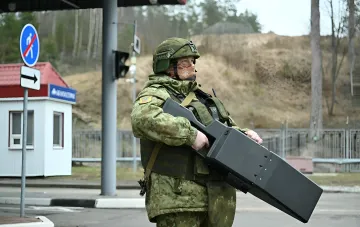
Against the backdrop of a series of incidents around the Baltic Sea, tensions between Russia and the Baltic states have reached a new point. On November 20, the Estonian government approved a decision to close all border crossing points on the border with Russia from December 1. According to the publication, the measure was taken after an attempted arson attack on a military-industrial enterprise near Tallinn, which is allegedly producing drones for Ukraine. On November 23, the Russian Foreign Ministry summoned the Estonian Chargé d'Affaires and conveyed a "resolute protest" over the "groundless accusation" of Moscow in the arson and the subsequent closure of the border. The ministry also stated that, in its view, Tallinn is allowing Ukrainian drones to use Estonian airspace to attack northwestern Russia, and called the events actions "on the verge of unleashing an open war with Russia."
Lithuania and Latvia: from support to cautious caveats
In Lithuania, the prime minister called Estonia's plans to close border crossings justified and suggested that Vilnius might adopt a similar decision. In the night of November 21, authorities in the Kaliningrad region reported an alarm in the Neman district due to a "suspicious object from the Lithuanian side"; according to them, after checks the threat was not confirmed. The Lithuanian Foreign Minister stated that the republic had not permitted the use of its airspace for strikes on Russia, and called false the claims circulating on social media about Vilnius's involvement in the alleged UAV attack. In Latvia, meanwhile, authorities are considering the possibility of closing or restricting the operation of crossing points, while the prime minister called Estonia's decision to close all crossings a mistake and emphasized that such measures should be taken jointly by all three Baltic countries; the government's "clear position," he said, would be presented by next week. On the morning of November 25, alarm sirens were activated across Latvia during a scheduled check.
Poland: note of protest and the missile dispute
In Poland, the day before the Russian ambassador was summoned to the Foreign Ministry and handed a "very sharp diplomatic note" over the fact that, according to Warsaw, on November 20 three Russian Kh-101 missiles violated the country's airspace. The ambassador himself rejected the accusations as "baseless, groundless and unsupported by evidence," and the diplomatic mission stated that the rhetoric is aimed at "stoking anti-Russian sentiments." Meanwhile, the Polish Deputy Minister of National Defense called for not severing diplomatic relations with Russia, believing that expelling the ambassador could ultimately lead to the start of a war.
Gulf of Finland: strike on a vessel and Berlin's reaction
On November 21, drones struck the Russian military vessel Sparta II in neutral waters of the Gulf of Finland; a fire broke out on the cargo ship and the crew was evacuated to a neighboring vessel. Volodymyr Zelensky later confirmed that the ship was attacked by Ukrainian drones. The German Defense Minister called on Kyiv not to extend the conflict to the Baltic Sea. The combination of these events — the border closure, mutual diplomatic summonses, disputes over airspace and the strike on a vessel in neutral waters — forms a picture of multi-vector escalation in the region, where each side interprets the opponent's actions as escalation.